






A critical vulnerability does more than expose a flaw in software. It exposes how quickly an organization can understand its infrastructure, make a safe change and prove that the change worked.
PHP2Shell brings that challenge into focus. For CIOs, security leaders and platform teams, the immediate task is to address affected runtimes. The larger task is to stop unsupported technology from turning each new advisory into another emergency.
What PHP2Shell makes urgent
On 21 October 2026, PHP released fixes for CVE-2026-109618 and CVE-2026-109619, which can permit unauthenticated remote code execution. The release addressed web-serving PHP deployments and identified Apache mod_php as the highest-risk configuration. The fixed releases announced that day were 8.2.35, 8.3.36, 8.4.27 and 8.5.12. Consult the current PHP security advisory and your distribution’s guidance when choosing a package.
PHP 8.1 and earlier are outside regular upstream support. Some distribution and long-term-support vendors provide backports; the PHP team also supplied limited source backports for this emergency. That distinction matters: an unsupported branch needs an explicit support and migration decision, rather than an assumption that a routine update will arrive.
Technology debt becomes response debt
A legacy application may appear inexpensive to retain while it continues to serve requests. Its hidden cost becomes visible when a critical advisory arrives.
The security team needs an exposure assessment. The application owner needs a compatibility decision. Operations needs a deployment and rollback plan. Leadership needs to know whether the affected service handles customer transactions, sensitive information or a less critical internal process.
When those answers live in separate tools and individual memories, every handoff adds delay. A finding can sit in a ticket while teams debate who owns it, which runtime is actually serving traffic and whether the proposed change could interrupt the business.
This is the operational cost of technology debt: the organization must reconstruct the same missing context under pressure, repeatedly.
Run emergency response and debt reduction together
The immediate response and the long-term repair need different work streams, with a shared owner.
Emergency response should establish exposure, select an approved treatment and verify its effect. Debt reduction should address why a business service still depends on software without a sustainable support path.
Closing the emergency ticket without funding the migration leaves the underlying problem in place. Waiting for a large modernization project before reducing today’s exposure leaves the immediate risk unresolved.
A useful leadership question is: which unsupported components remain in important services, and what funded decision will remove each dependency? The answer should identify an owner, a target state, a delivery date and a time-bounded exception where necessary.
Turn a finding into an operational decision
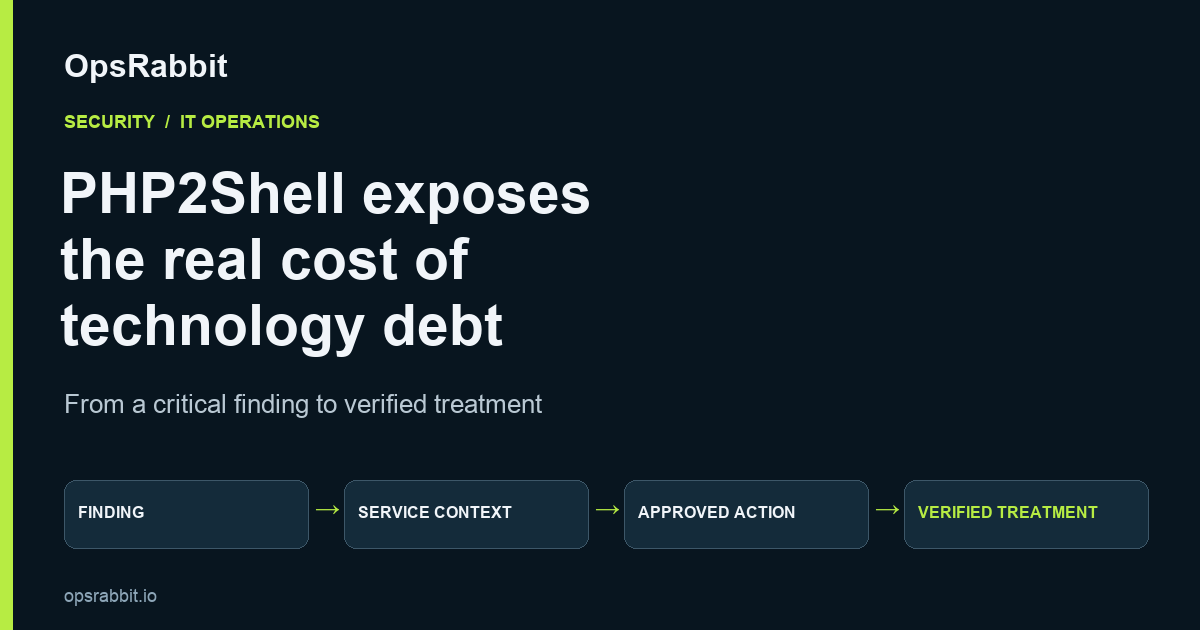
Treat the following as a response workflow for the team, with evidence attached at each step.
-
Establish the running scope. Connect inventory findings to the workloads actually serving requests. Check the runtime, package source, deployment image and relevant configuration. Separate confirmed facts from assets that still need inspection.
-
Connect exposure to the business. Identify the service owner, public reachability, sensitive workflows and affected dependencies. Technical severity informs priority; service context determines the operational response.
-
Choose the treatment. A supported installation may need an update. An unsupported one may require a supported build, a migration or a vendor-supported backport. Any interim restriction needs an owner, an expiry and a path to a durable fix.
-
Prepare the change. Define compatibility checks, rollout scope, approval requirements and rollback criteria before execution. Identify how the team will detect a failed deployment or a customer-facing regression.
-
Verify the outcome. Check the runtime actually handling traffic, the intended configuration and application health. Retain the evidence behind closure and keep unresolved assets visible.
Where OpsRabbit helps
OpsRabbit supports the investigation and decision work around operational changes. It connects service ownership and dependencies with available logs, metrics, deployment changes and incident history, then produces findings and recommended next steps for engineering review. Its operating model uses scoped access, read-only investigation by default and approval gates for state-changing actions. Explore OpsRabbit.
For a PHP response workflow, the practical opportunity is to reduce the time engineers spend assembling context. With the relevant connections and procedures configured, teams can use an investigation thread to examine a service’s dependencies, review recent changes, identify unanswered questions and prepare a clearer handoff to the people responsible for remediation.
That is a useful place to apply AI: collecting and organizing evidence that helps an authorized owner act. A runtime upgrade still needs a suitable build, application validation and a controlled deployment. The response is complete only when the team has checked the result in the affected service.
Make a 24-hour objective executable
For the most exposed, business-critical systems, a 24-hour treatment objective can be a useful management target. It needs to be defined as an organization’s objective, with explicit scope and escalation rules—not a universal promise that every vulnerability can be fully patched in a day.
The clock should include investigation, ownership, approval, execution and verification. Measuring only the deployment step hides the waiting time that often determines the outcome.
When permanent remediation cannot meet the target, require a documented interim treatment, a named risk owner and a dated plan for the remaining work. An exception without an expiry can quietly become the next generation of technology debt.
Measure risk reduction rather than ticket movement
A closed ticket tells leadership that a workflow changed status. It does not, on its own, establish that the vulnerable runtime stopped serving traffic.
Track time to a confirmed scope, time to an accountable owner, time to verified treatment and the age of unresolved exceptions. For unsupported technology, also track whether the business has funded and delivered the migration plan.
These measures connect security work to operational decisions. They help leaders see whether the organization is becoming better at removing exposure or simply becoming faster at processing findings.
Build the response before the next advisory
If AI compresses the time between discovering a vulnerability and attempting to exploit it, an organization cannot rely on repeated manual coordination to keep pace. The response needs a repeatable path from finding to evidence, decision, approved action and verification.
PHP2Shell is a reason to examine both the immediate runtime risk and the operating model behind it. Unsupported software should have an owner and an exit plan. Critical findings should reach the people who can act with the context they need.
Bring one critical service to an OpsRabbit walkthrough. See how your team can connect operational evidence, prepare a remediation handoff and define what verified closure should look like. Explore OpsRabbit.