Quick answer: The agentic SOC can make triage faster, but operations teams still get stuck when they cannot quickly assemble service ownership, recent changes, runtime evidence, and the next safe action. That gap is time-to-context, and it is where a lot of incident response still slows down.
TL;DR
- The agentic SOC is a real shift, and it is pushing investigation workflows forward.
- But faster detection or faster triage does not automatically mean faster response.
- Ops teams still need to understand what changed, what is affected, who owns it, and what to do first.
- The practical metric sitting between detection and remediation is time-to-context.
What problem are we solving?
There is a lot of momentum behind the phrase agentic SOC right now.
Microsoft's recent framing is useful because it is concrete. The idea is not just "more AI in the SOC." It is a layered operating model where autonomous protections stop high-confidence threats and AI agents help assemble evidence, correlate activity, and suggest likely next steps.
That is a meaningful improvement. It should reduce noise and help security teams get to the right starting point faster.
But there is still a familiar moment that many incident responders know too well.
A security signal appears. An alert fires. Maybe a vuln story lands. Maybe someone spots weird auth behavior. Maybe an admin endpoint looks exposed.
And then everyone asks the same questions:
- Which services are actually affected?
- What changed recently?
- Is this tied to a deploy, a config change, or something external?
- Who owns the systems that need action first?
- What evidence is strong enough to justify containment, rollback, or escalation?
That is the point where incidents still get sticky.
Short answer
The agentic SOC improves the front half of response, especially around triage and evidence gathering. It does not remove the need for trusted operational context. Teams still need a fast way to connect alerts, changes, service ownership, telemetry, and next actions before they can respond confidently.
Why this matters right now
This is not just trend-chasing.
Microsoft says the agentic SOC model is about combining autonomous defense with AI agents that pre-assemble evidence and reduce time spent on repetitive execution. At the same time, Google Threat Intelligence Group is reporting that threat actors are increasingly using AI to accelerate reconnaissance, phishing preparation, and malware-related work. In plain language, defenders are under pressure to get faster while incidents get noisier and more complex.
That is exactly why the operations layer matters.
IBM's Cost of a Data Breach research also points to the value of faster identification and containment. If quicker containment lowers cost, then the time between signal and confident action is not just an internal process problem. It is a business problem.
Where response still slows down
The hard part is rarely awareness.
Teams usually learn that something is wrong pretty quickly. The slowdown comes after that, when they need to build a usable story from scattered systems.
A modern incident might require responders to pull from:
- detection and alerting tools
- logs, traces, and metrics
- recent code or config changes
- asset inventory
- service ownership
- change tickets
- chat threads
- vulnerability context
All of those things can exist. That does not mean they show up in one place, at the right time, in a form that helps someone act.
That is why a lot of response work still feels like assembly, not decision-making.
Time-to-context is the metric hiding in the middle
We talk a lot about time-to-detect and time-to-resolve.
Those are useful. But there is another operational metric sitting between them: time-to-context.
Time-to-context is the time it takes to move from "something looks wrong" to "we know enough to take the next safe step."
That next step might be containment. It might be rollback. It might be escalation. It might be deciding that the issue is narrower than it first looked.
Either way, teams need context they trust.
And this is where incidents still lose the most time.
A concrete example: when AI-connected tooling becomes an ops incident
The recent nginx-ui flaw is a good illustration.
On paper, it is a security issue involving MCP-connected endpoints and authentication problems. In practice, it quickly becomes an operations incident. Responders need to know where nginx-ui is exposed, which versions are running, whether configuration changed unexpectedly, whether reloads happened, what production paths depend on that layer, and who owns the affected systems.
That is a context-assembly problem before it becomes a remediation success story.
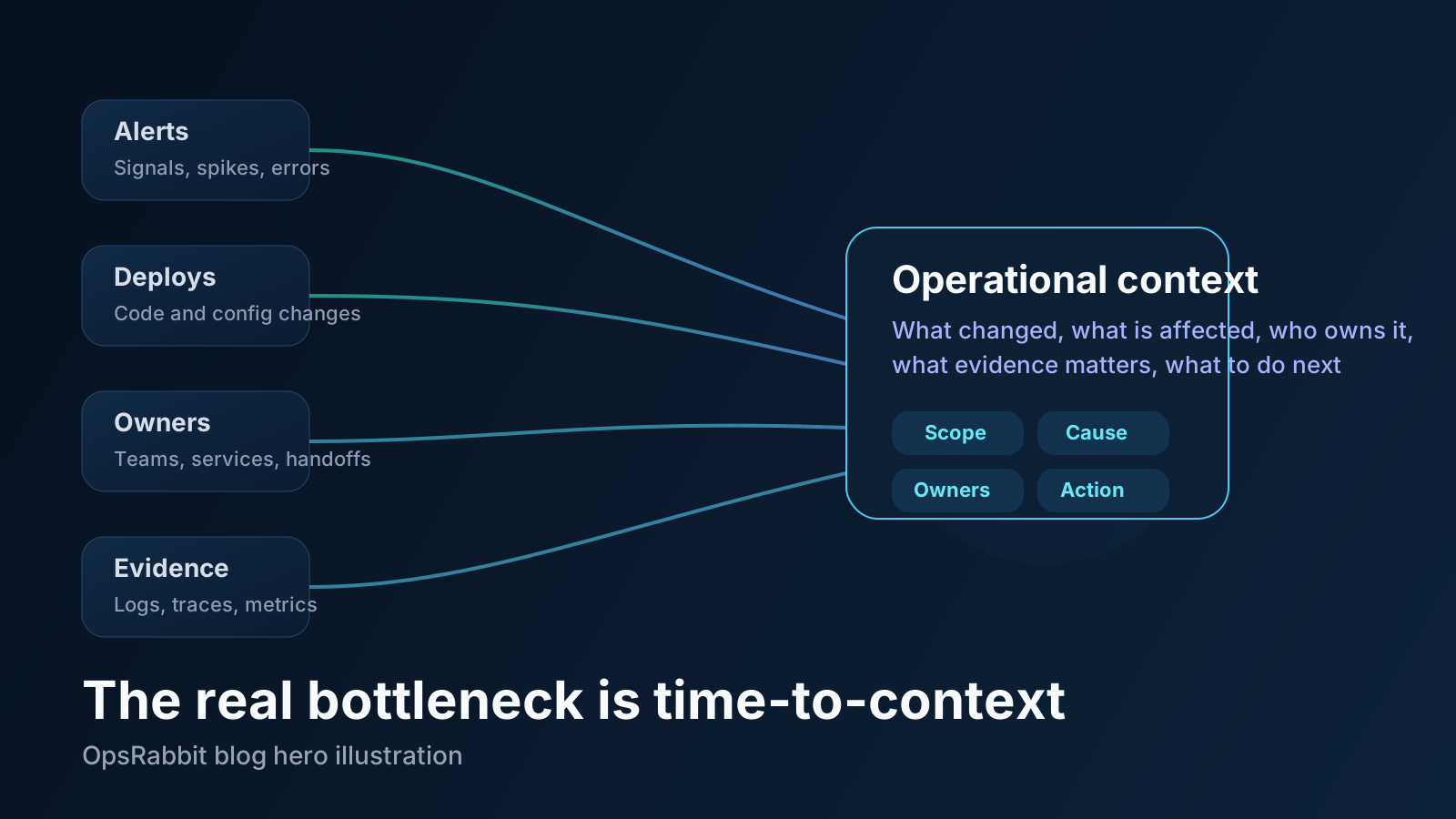
The fastest teams are not just faster at detecting problems. They are faster at building enough context to act.
Praetorian's MCP research makes the broader point clearly too: AI-connected integration layers can create a meaningful new attack surface. Once those integrations touch admin planes or production control paths, incident response has to cover them like any other privileged operational surface.
What a useful AI investigation layer should actually do
For operations teams, a genuinely helpful AI investigation layer should be pretty boring in the best way.
It should help answer the first-response questions quickly and with enough evidence to support action:
- what changed
- what systems or services are affected
- who owns them
- what symptoms correlate across telemetry
- what likely path explains the incident so far
- what next actions are most worth validating first
That is different from just summarizing alerts.
The goal is not another clever interface. The goal is a better starting point for responders.
Where OpsRabbit fits
This is the gap OpsRabbit is built for.
OpsRabbit is not trying to replace every security product or every observability tool. The more practical job is to reduce the time it takes responders to build usable incident context.
That means helping teams get faster answers to the questions they actually ask during a live issue:
- what changed
- what is affected
- who should respond
- what evidence matters most
- what should happen next
If the industry keeps moving toward the agentic SOC, this layer becomes more important, not less. Faster upstream triage increases the value of faster downstream context.
Final thought
I think the agentic SOC is a real and useful direction.
But if operations teams still spend the first 20 or 30 minutes of an incident jumping between tools, deploy records, ownership docs, and chat threads just to understand what is happening, then the bottleneck has not moved as much as people hope.
That is why time-to-context matters.
The teams that respond best are not only the ones that detect faster. They are the ones that can turn scattered signals into trusted operational context quickly enough to act.
That is the gap worth closing.
FAQs
What is time-to-context in incident response?
It is the time it takes to move from a raw signal to enough trusted operational context to take the next safe action.
Why is faster alert triage not enough on its own?
Because responders still need to know what changed, what systems are affected, who owns them, and what evidence supports the next step before they can act confidently.
Sources
- Microsoft Security, The agentic SOC, Rethinking SecOps for the next decade - accessed April 18, 2026.
- Google Cloud, GTIG AI Threat Tracker: Distillation, Experimentation, and Integration of AI for Adversarial Use - accessed April 18, 2026.
- IBM, Cost of a Data Breach 2025 - accessed April 18, 2026.
- The Hacker News, Actively Exploited nginx-ui Flaw Enables Full Nginx Server Takeover - accessed April 18, 2026.
- Praetorian, MCP Server Security: The Hidden AI Attack Surface - accessed April 18, 2026.
Last Updated
2026-04-18
Ready to Transform Your Operations?
Ask for a demo today. Experience how OpsRabbit can reduce your MTTR by up to 90%.