Quick answer: Repository ownership is no longer just governance metadata. It is the control that tells teams who can review, rotate, archive, or safely change something once a security alert or production incident hits code.
TL;DR
- GitHub recently showed that fewer than half of its 14,000+ internal repositories had clear ownership before it fixed the problem.
- The ownership gap became painful during secret-scanning cleanup because a finding without a responsible owner is hard to remediate safely.
- CODEOWNERS helps with review routing, but teams usually need broader repository ownership metadata for escalation, lifecycle, and archival decisions.
- If your team can detect a problem but still cannot answer who owns the repository, you still have an incident-response bottleneck.
What problem are we solving?
Security and platform teams rarely struggle to detect signals anymore.
They have secret scanning, pull-request review, dependency alerts, CI logs, code search, and internal tickets. The slower part often starts one step later:
- Which repository actually matters here?
- Is it still active?
- Who owns it?
- Who can approve a safe fix?
- Is this a team-owned system, a personal experiment, or an abandoned repo nobody should still depend on?
That is where repository ownership stops being a governance footnote and becomes response infrastructure.
Why this matters right now
GitHub's July 9 durable-owner writeup makes the issue unusually concrete.
GitHub said it had more than 14,000 repositories in its primary internal organization and that fewer than half had clear ownership. It also said the gap became a recurring problem during secret-scanning remediation, because teams could technically rotate a secret but still had no reliable way to route the work safely if they could not identify the repository owner.
That is a familiar pattern for many teams.
The problem is not detection alone. The problem is what happens after detection, when a signal has to become a safe next action.
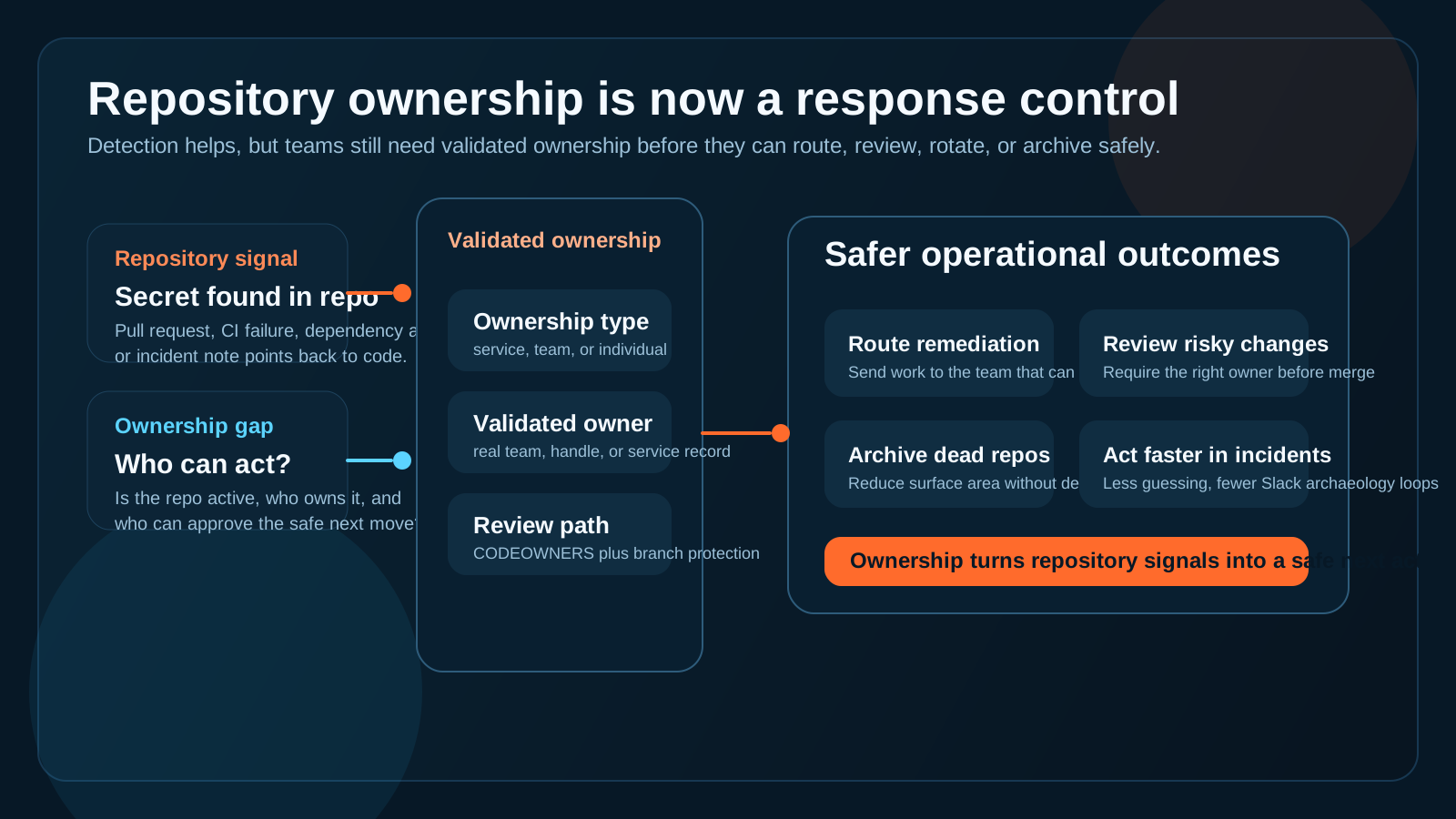
Ownership matters because it turns a repository signal into a routed, reviewable, and safer next action.
What GitHub's durable-owner rollout changed
GitHub treated repository ownership as a first-class property instead of an assumption.
The practical pieces are worth noticing:
- it synced ownership automatically for service-backed repositories
- it created structured ownership fields instead of relying on guesswork
- it validated whether a person, team, or service entry was actually real
- it archived repositories that stayed unowned after a grace period
- it made ownership mandatory for new repositories
That is a strong operating pattern because it does two things at once:
- it improves routing during active work
- it reduces surface area by pushing dead repositories out of the active path
GitHub's secret-scanning cleanup explains why that matters. It found more than 20,000 secret-scanning alerts across 15,000 repositories, and the work only became manageable once teams could separate noise from real risk, identify ownership, and route remediation safely.
That is the deeper lesson.
Repository ownership is not only about stewardship. It is about being able to act safely when the backlog gets real.
Where CODEOWNERS helps, and where it does not
GitHub's CODEOWNERS documentation is still highly relevant here.
CODEOWNERS can automatically request review from responsible users or teams when a pull request touches specific files, and branch protection can require approval from code owners.
That is valuable.
But CODEOWNERS is not the whole ownership model.
It helps answer:
- who should review this change
- who owns this path in the base branch
It does not fully answer:
- is the repository still active
- who owns the repository as a system, not just a path
- which team should rotate a secret or approve archival
- whether the listed owner is still valid at organization scale
That is why the durable-owner story is bigger than branch review.
A practical five-step ownership rollout
If I were implementing this today, I would keep it simple.
1. Inventory active repositories
Start with reality, not policy.
Find which repositories are active, which are stale, and which clearly back production services versus docs, tools, or experiments.
2. Define a small ownership taxonomy
Most teams do not need ten ownership types.
Service, team, and individual are often enough to start, as long as the rules for each are clear.
3. Validate owners against real systems
An owner field is only useful if it maps to a real team, a current employee, or a live service record.
4. Connect ownership to review and remediation workflows
This is where CODEOWNERS, branch protection, escalation paths, and security routing should line up.
5. Enforce and archive
If a repository cannot maintain valid ownership, it should not stay in the same active state as production-adjacent code.
Archival is often the least destructive way to reduce ambiguity.
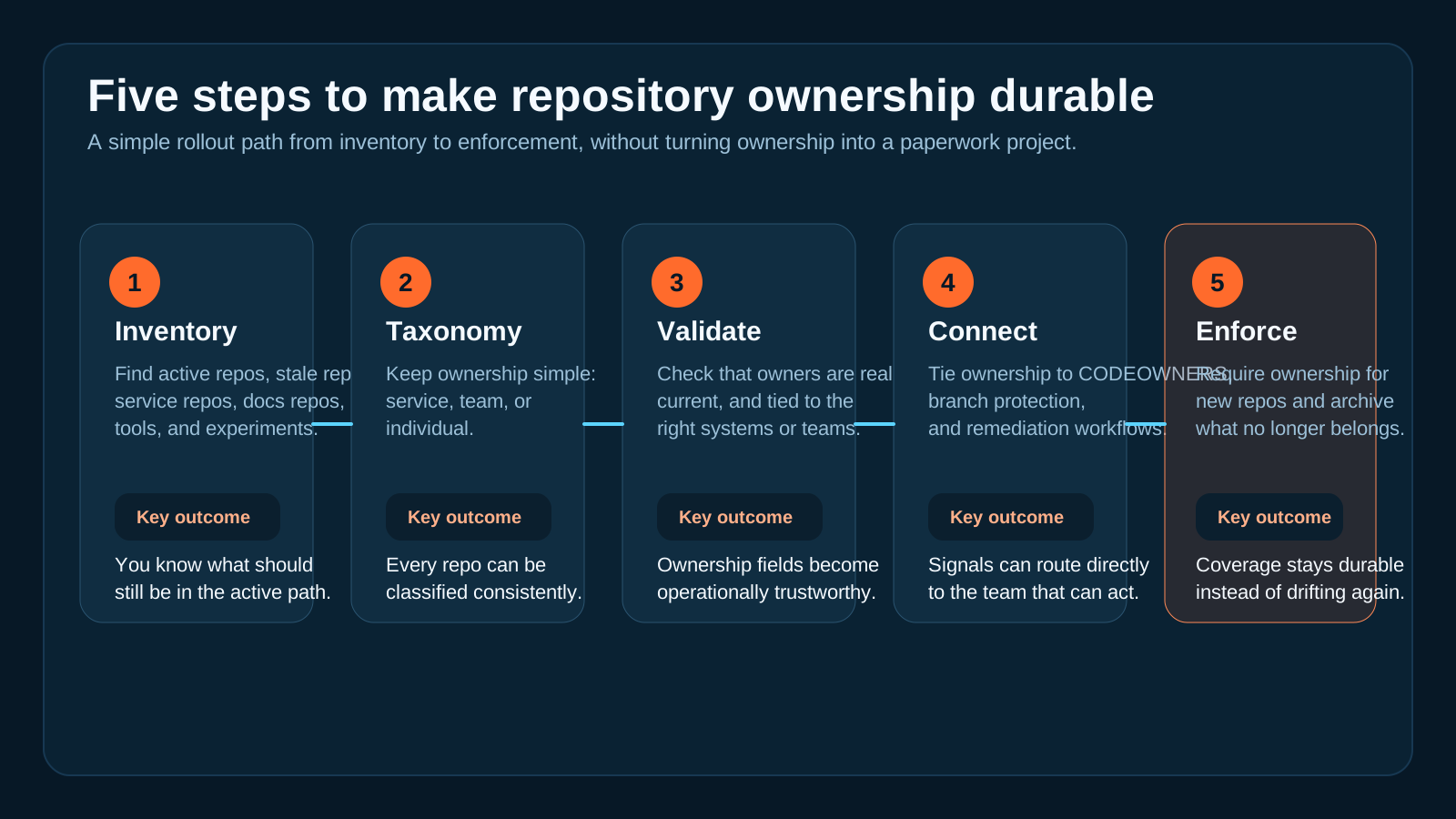
A practical ownership program starts with inventory, then moves through validation, review routing, and enforcement.
Why this becomes an incident problem so quickly
GitHub's May 2026 investigation update is a useful reminder that response work gets operational fast.
After detecting a compromise involving a poisoned VS Code extension, GitHub said it rotated critical secrets quickly and later rotated the GitHub Enterprise Server signing key out of caution. That is exactly the kind of moment when repository context stops being abstract.
The team needs to know:
- which repositories are affected
- who can take action
- whether the repo is still part of a live workflow
- how to avoid breaking something important while remediating quickly
That is the sort of work that slows down when ownership is fuzzy.
Where OpsRabbit fits
OpsRabbit is useful in the gap between the signal and the first safe move.
If a security finding lands in a repository and the team still needs to assemble ownership, recent changes, affected systems, and the safest next step, OpsRabbit helps compress that context loop.
That means less time asking around, less guesswork in Slack, and fewer delays between "we found the issue" and "we know who should act first."
Final thought
Repository ownership is easy to treat like administrative cleanup until a real remediation backlog proves otherwise.
Then it becomes obvious: if your team can detect a problem but still cannot route it, review it, or change it safely, you do not just have a metadata problem.
You have a response problem.
If your ownership model still depends on reading commit history, guessing in Slack, or hoping the right reviewer appears, this is a good time to fix it before the next secret leak, risky change, or production incident makes the cost visible.
FAQs
Why is repository ownership an incident-response issue?
Because detection is not enough. Teams still need to know who can review, rotate, approve, archive, or safely change a repository once an alert lands.
Is CODEOWNERS enough by itself?
No. CODEOWNERS helps route pull request review, but teams usually still need broader repository ownership data for lifecycle, escalation, and remediation decisions.
Sources
- How GitHub gave every repository a durable owner - GitHub Blog, July 9, 2026.
- How GitHub used secret scanning to reach inbox zero - GitHub Blog, July 2, 2026.
- About code owners - GitHub Docs, accessed July 21, 2026.
- Investigation update: GitHub Enterprise Server signing key rotation - GitHub Blog, updated May 26, 2026.
Last Updated
2026-07-21
Ready to Transform Your Operations?
Ask for a demo today. Experience how OpsRabbit can reduce your MTTR by up to 90%.