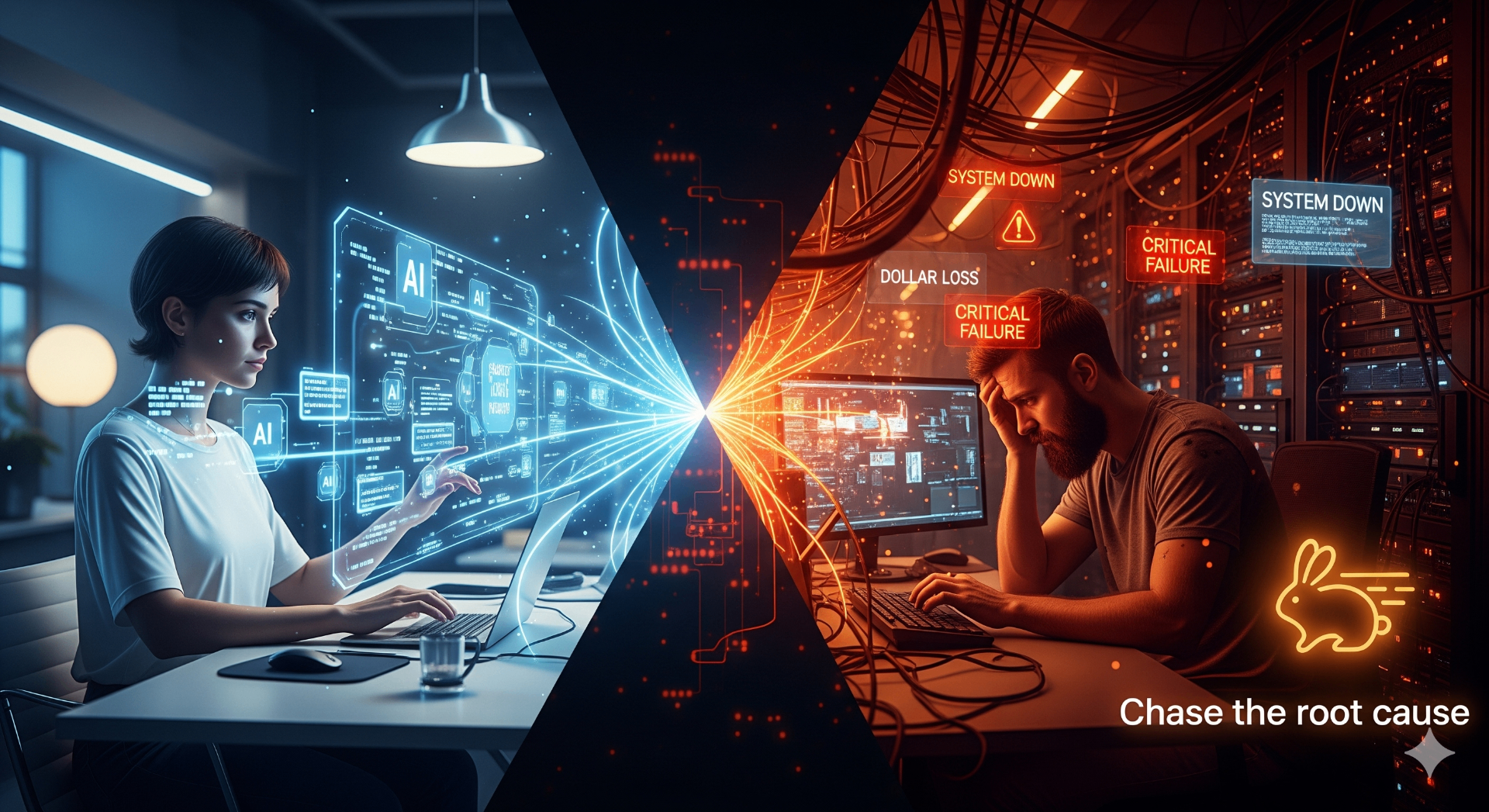
Quick answer: AI-assisted development increases release velocity, but it can also increase incident complexity; OpsRabbit helps ops teams recover faster with investigation context and automated evidence correlation.
The pager goes off at 3 a.m. again. Your heart sinks. You roll over, grab your laptop, and start the familiar, bleary-eyed ritual of sifting through logs, alerts, and tool silos. That new AI-generated code that shipped today? It's the prime suspect. As developers move faster, the unseen cost lands squarely on SRE/CloudOps/IT Ops shoulders.
The New Reality for Ops
AI coding tools are everywhere. GitHub Copilot, Cursor, OpenAI Codex, Claude Code, Tabnine, and CodeWhisperer are now part of everyday development. They've made it possible to ship features faster than ever before.
This speed comes with a cost. AI code often arrives in production with hidden dependencies, fragile integrations, and edge cases that were never fully tested. Even the developers who commit it may not fully understand how the generated modules behave once they go live.
Ops teams are left to pick up the pieces.
Can Your Ops Team Keep Up With the Pace of AI?
The new wave of AI-generated code isn't just a volume problem; it's a personal one. It lands on the laps of IT Ops and SRE teams, forcing them to shoulder the burden of a system they didn't architect and often don't fully understand. Your on-call rotation is about to get a lot heavier.
- Manual RCA: Drowning in logs and alerts, engineers are left hunting for a needle in a haystack of data.
- Tool silos: Monitoring platforms like Datadog or Dynatrace are powerful, but each one only looks at part of the stack. The big picture is missing.
- Runbooks that drift: Playbooks quickly fall out of date and cannot keep pace with AI-driven changes.
- On-call fatigue: Engineers are woken up by a flood of alerts, many of which lead nowhere, creating stress and attrition.
The stakes are high. Industry research puts the average cost of downtime at more than $5,000 per minute. With that kind of money on the line, slow investigations are not an option.
Meet Your AI Teammate: The Missing Link in Your Production Environment
The missing link in this ecosystem is a partner that understands production. While coding copilots accelerate development, they go silent the moment code goes live. OpsRabbit fills that silence, becoming the intelligent bridge between the accelerated world of code and the stable reality of production.
It integrates directly into Slack or Teams and begins working as soon as an alarm fires.
Here's what happens in practice:
- An alert comes in from Datadog, Zabbix, or CloudWatch.
- OpsRabbit builds a Service Knowledge Graph that shows dependencies and past incidents.
- An AI Correlation Engine pulls data from logs, traces, code diffs, and APIs.
- Within two minutes, a complete Root Cause Analysis is posted into Slack with supporting evidence.
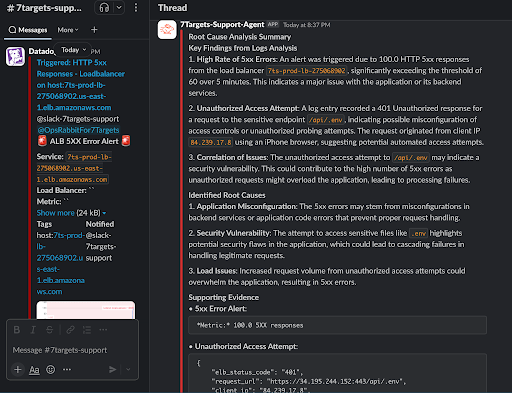
Fig: OpsRabbit investigation and RCA
Instead of starting with guesswork, engineers get the context they need to take action right away.
From 30–45 Minutes to 3–5: The End of "Log Hunting"
Imagine a scenario: It's 3 a.m. The alarm screams. Your engineer, bleary-eyed, knows the clock is ticking. The industry average for a manual RCA is 30–45 minutes of tedious "log hunting." OpsRabbit reduces that grind to just 3–5 minutes, providing the context you need to act, not sift. If the first pass isn't enough, it runs a second investigation to go deeper before returning results.
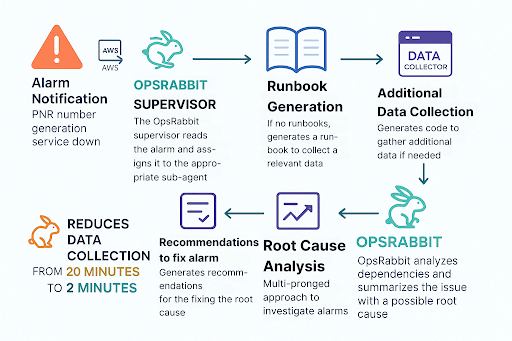
Fig: How - From 30–45 Minutes to 3–5: Automated Incident Data Collection
This isn't another dashboard that people forget to check. It's an investigation partner that works where the team already collaborates.
What This Looks Like in the Real World
In one SaaS environment, OpsRabbit connected to CloudWatch and Datadog within a few hours. On day one it caught a recurring API error, traced it to a hidden dependency in an authentication service, and flagged it before users felt the impact.
In another setup, a financial services team was drowning in storage-related alerts. OpsRabbit quickly tied the alerts to a single misconfigured Terraform change, preventing what could have been a major outage.
In both cases, what would have taken hours of manual digging was resolved in minutes inside Slack.
Value Proposition & Evidence Matrix
The following table organizes the key value propositions of OpsRabbit and maps them to the strongest supporting evidence from the research, providing a clear and comprehensive overview of the product's value.
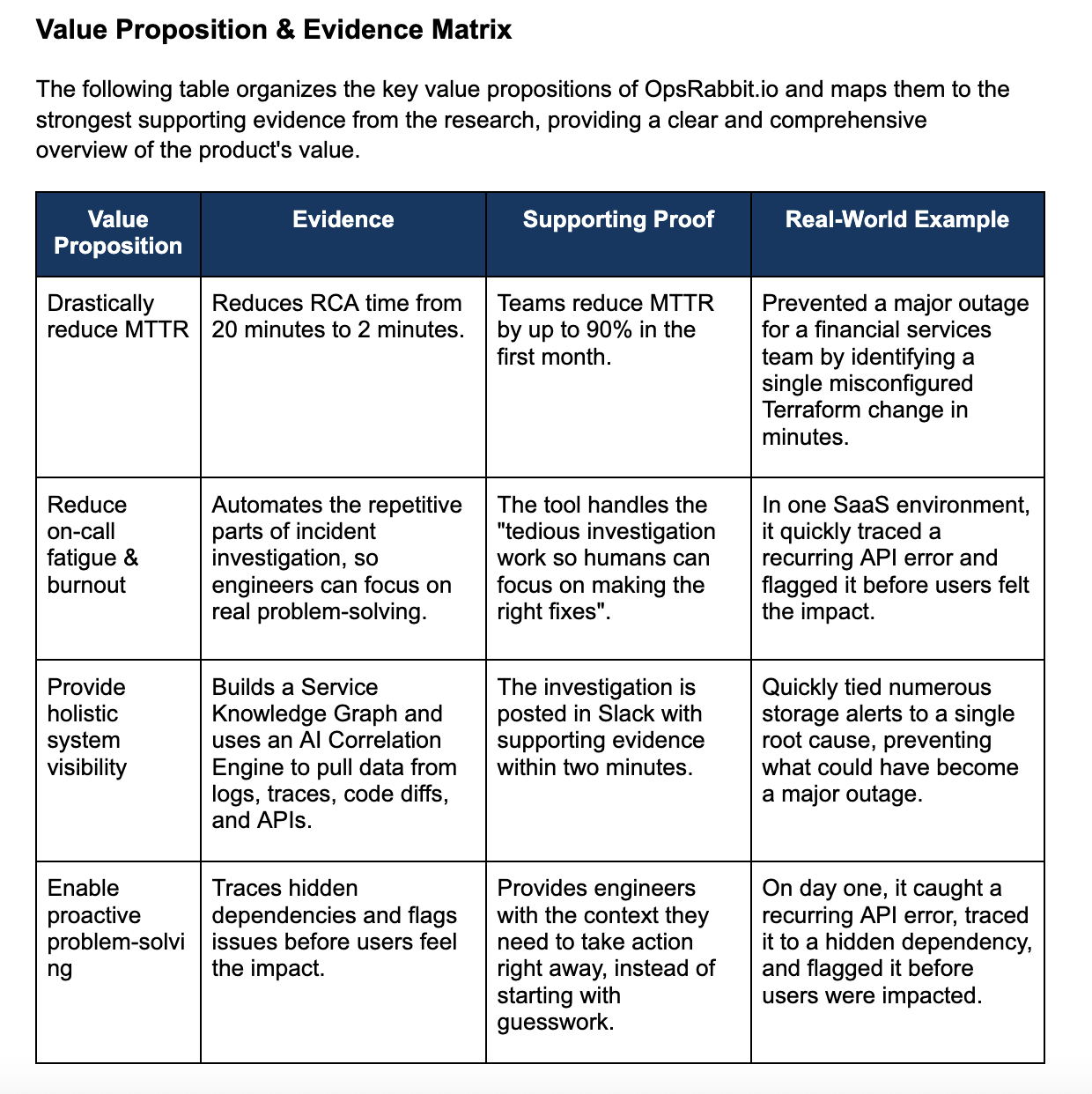
Fig: Value Proposition & Evidence Matrix
This evidence-based approach demonstrates how OpsRabbit addresses the core challenges facing modern operations teams. From drastically reducing MTTR to preventing burnout through automation, each value proposition is backed by concrete proof and real-world implementations.
Why Copilots Alone Are Not Enough
Coding copilots are designed to accelerate development. They don't monitor production. They don't explain why services fail in the middle of the night. They don't prevent alert fatigue.
OpsRabbit takes on that role. It acts as the AI Production Engineer, handling the tedious investigation work so humans can focus on making the right fixes and improving resilience.
Common Questions
Why can't coding copilots help with incidents? They are built for writing code, not for monitoring or troubleshooting live systems.
How many incidents are still manual today? Around 80 percent. That is why MTTR remains stubbornly high across most organizations.
How does OpsRabbit help reduce burnout? By automating the repetitive parts of incident investigation, engineers avoid long nights of log hunting and focus on real problem solving.
Which tools does it integrate with? OpsRabbit works with Datadog, Zabbix, CloudWatch, Dynatrace, Prometheus, PagerDuty, ServiceNow, Jira, Slack, and Teams.
How quickly can a team see results? Most teams see root cause analysis delivered within the first week of onboarding. Many reduce MTTR by up to 90 percent in the first month.
Closing Thoughts
AI code is rewriting the rules of software development. For developers it means speed. For Ops teams it means complexity and constant firefighting. Manual RCA and siloed tools are no longer enough to keep up.
OpsRabbit closes this gap. It gives Ops and SRE teams an AI teammate that investigates incidents, provides evidence-backed RCA, and helps keep critical services reliable.
🚀 We are running early pilots with teams who want to get ahead of this shift.
👉 Ready to stop the late-night firefights? Request an exclusive spot in the OpsRabbit pilot program to see our AI teammate in action on your own alerts.
Ready to Transform Your Operations?
Ask for a demo today. Experience how OpsRabbit can reduce your MTTR by up to 90%.