Quick answer: Least privilege for AI agents fails when teams stop at IAM roles. Real control needs identity ownership, task-scoped access, tool allowlists, downstream authorization checks, audit trails, and a tested kill switch.
TL;DR
- Microsoft's July 16 guidance turns least privilege for AI agents into something more concrete than "use smaller roles."
- The real failure mode is operational: teams cannot explain who owns the agent, what it can do across tools, what changed recently, or how to shut it down cleanly.
- Google's VPC Service Controls guidance reinforces that valid identity alone does not stop a compromised agent from trying to move data where it should not.
- The safest pattern is a repeatable ops workflow: owner, scope, tools, audit, revocation.
What problem are we solving?
Least privilege sounds straightforward until agents start chaining actions across systems.
An agent that reads tickets, checks files, opens cloud consoles, and updates a runbook can look harmless when each permission is reviewed one by one. The trouble starts when those permissions combine.
Now the team has to answer harder questions:
- Does this agent have its own identity, or is it hiding behind a shared service account?
- Which actions are actually exposed through its tool set?
- Can downstream systems reject a call that the orchestrator mistakenly allows?
- If the workflow goes off the rails, who owns the kill switch?
Those are not one-time IAM questions. They are operating questions.
Why this matters right now
Microsoft's July 16, 2026 post on least privilege for AI agents is useful because it stops talking in slogans and gets specific. The post says agents should be treated as first-class principals with lifecycle-managed identities, explicit roles, tightly scoped permissions, controlled tool access, and end-to-end auditability.
Its companion Learn pattern goes even further. Microsoft recommends a dedicated agent identity with a named owner, denying unreviewed tools by default, logging identity plus role plus effective scope plus action plus correlation ID, and testing revocation paths before something goes wrong.
Google's June 26 update on VPC Service Controls adds the missing second half of the story. The point is not only who the agent is. The point is also where data is allowed to move. Google explicitly frames VPC Service Controls as a perimeter that can block exfiltration attempts from a compromised agent even when that agent has valid IAM credentials.
That combination matters:
- Identity and scope tell you what the agent should be able to do.
- Tool and perimeter controls limit where the workflow can go wrong.
- Audit and revocation decide whether responders can recover quickly when it does.
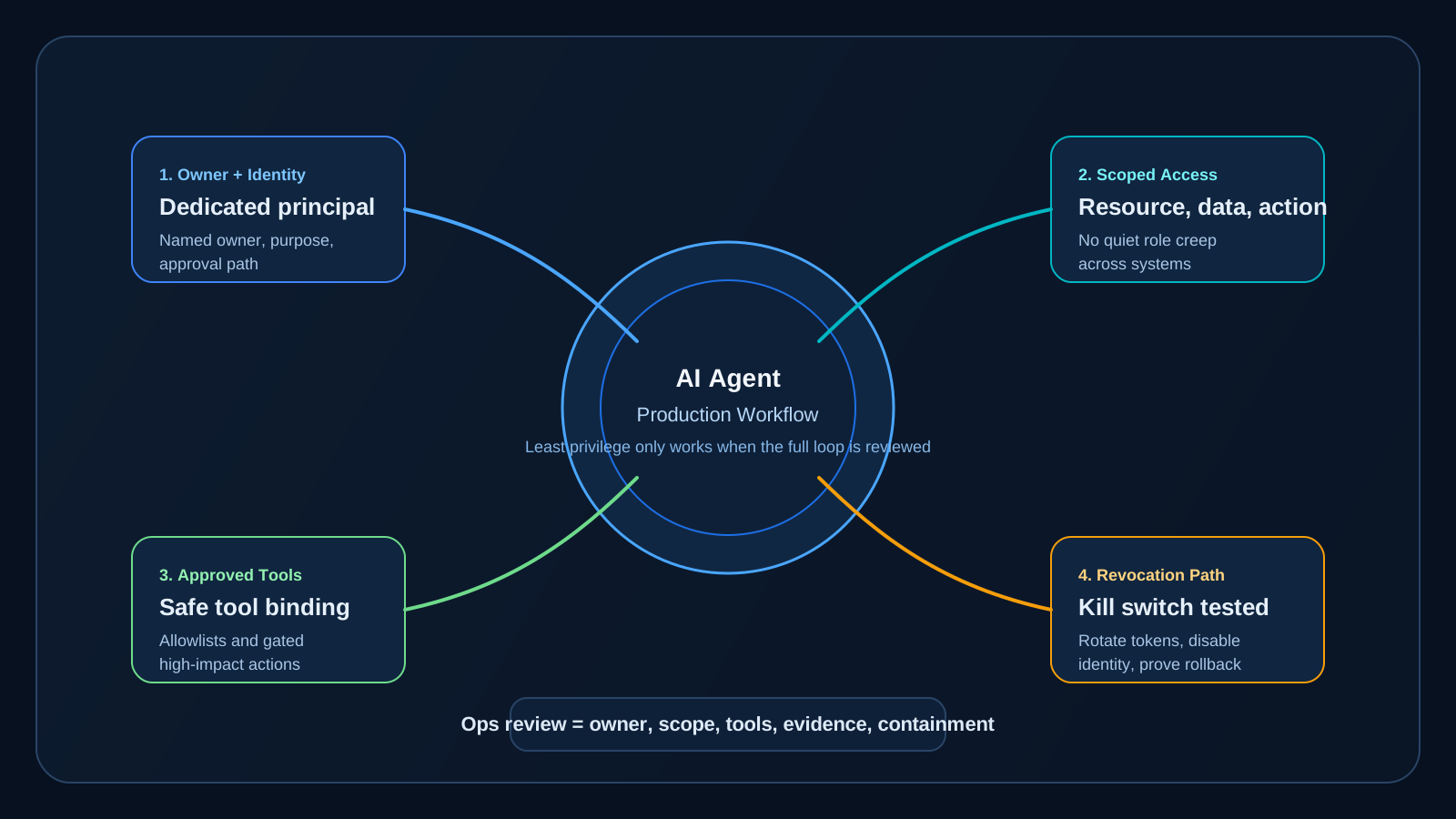
Least privilege only holds when identity, scope, tool policy, and containment are reviewed together.
Where least privilege breaks down in real deployments
The common failure mode is not "someone forgot RBAC exists."
It is usually one of these:
- A pilot starts with a broad reader or admin role because it is faster.
- The workflow expands from read-only to write actions, but nobody redesigns the permission model.
- Tool access grows quietly, so the agent can now correlate files, tickets, email, and cloud resources in ways that were never reviewed end to end.
- Logs show that a tool was called, but not which identity, effective scope, approval path, or downstream authorization decision made it possible.
- The team can disable the orchestrator, but shared credentials or cached tokens keep the blast radius alive longer than expected.
That is why "just use least privilege" is not enough. The hard part is keeping permissions understandable as the workflow evolves.
The five-part ops workflow for agent least privilege
If I were reviewing an agent-enabled workflow this week, I would want five things before calling it production-ready.
1. Give the agent a named identity and a named owner
Microsoft's guidance is clear here: treat the agent as a first-class principal.
That means:
- no shared secrets when a dedicated identity is possible
- one accountable owner for approvals and incident response
- a short purpose statement that says what the agent is allowed to do and why
If nobody owns the identity, nobody owns the cleanup.
2. Scope access by resource, data, and action
The useful phrase from Microsoft's pattern is not just "least privilege." It is scoped privilege.
Review access at three levels:
- resource boundary: which tenant, project, workspace, subscription, or site
- data boundary: which collections, labels, or sensitivity tiers
- action boundary: read, write, export, delete, admin, or privilege change
This is where teams often miss the real risk. A workflow can look low-risk in each system and still become high-risk once those permissions chain together.
3. Bind tools explicitly and gate the high-impact ones
Microsoft calls this safe tool binding. That framing is worth stealing.
Do not expose every available tool just because the agent might use it one day. Allowlist the specific actions the workflow needs, then add approval or time-bound elevation for higher-impact operations such as deletes, exports, or privilege changes.
That is the difference between an agent that can help and an agent that can surprise you.
4. Re-check authorization at every hop and log the evidence
One of the better points in the Microsoft pattern is that downstream tools and services must re-check claims, roles, and scope on each call instead of trusting the orchestrator.
That matters because weak integrations become the easiest place for a bad workflow to slip through.
At minimum, your logs should capture:
- agent identity
- role used
- effective scope
- tool invoked
- action taken
- target resource
- timestamps
- correlation IDs
- "on behalf of" user where applicable
Without those fields, an incident review turns into archaeology.
5. Test revocation before you need it
The kill switch should not be theoretical.
Microsoft explicitly recommends testing agent disablement, credential rotation, token invalidation, and stale permission removal. Google's VPC Service Controls guidance makes the case for complementary boundaries here too: if identity controls fail, perimeter controls can still help block where data goes next.
That is why revocation is an ops drill, not a policy paragraph.
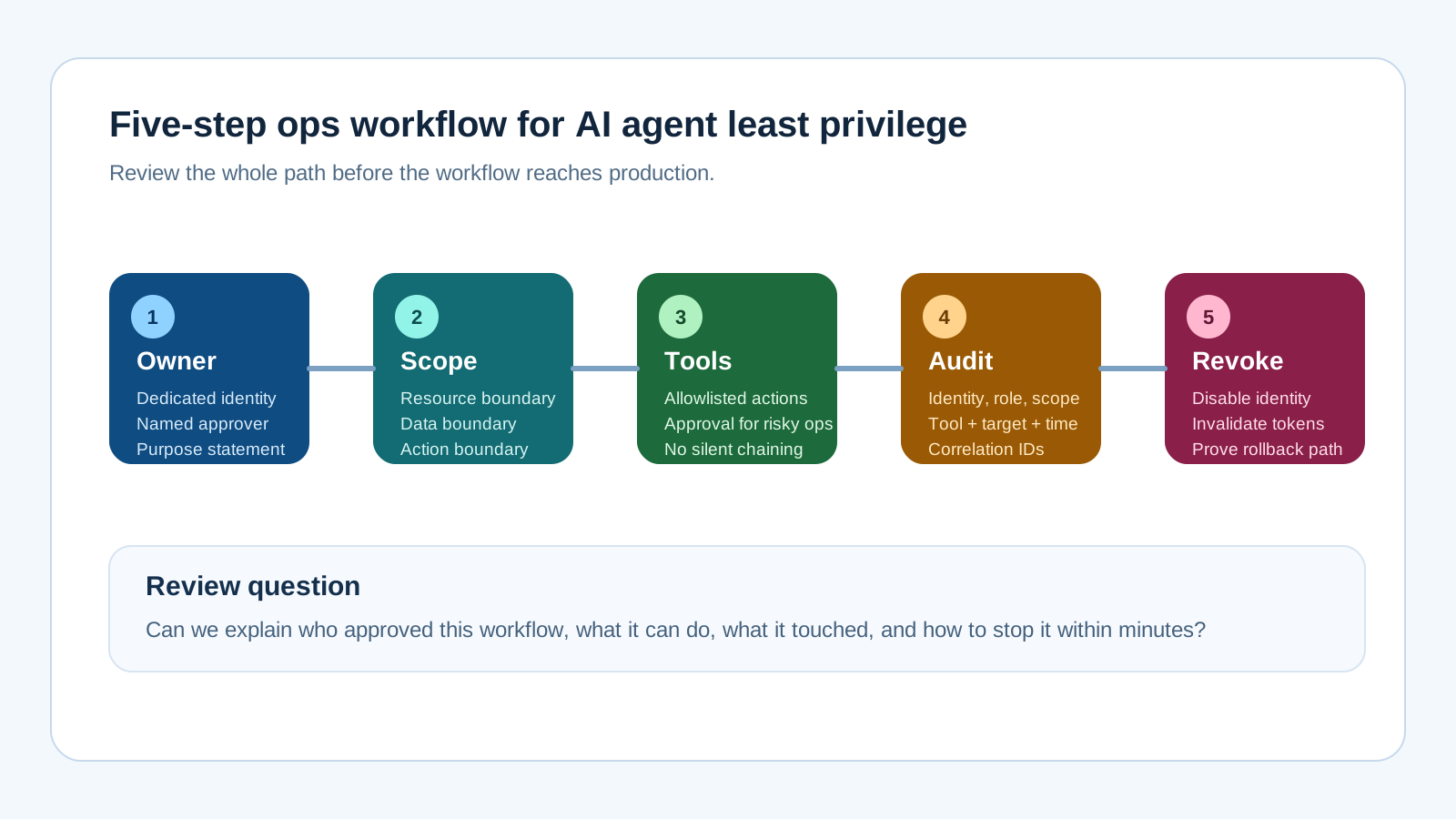
The healthiest review loop checks ownership, access, tool policy, evidence, and containment before the workflow spreads.
Where OpsRabbit fits
OpsRabbit does not replace IAM, agent identity platforms, or cloud perimeter controls.
It helps in the gap between "we think this workflow is fine" and "we need to explain what actually happened."
For agent least-privilege reviews and incidents, that means helping teams assemble:
- the owner and workflow context
- the connected systems and likely blast radius
- the recent changes that matter
- the evidence trail across logs, tickets, and tools
- the safest next step for containment or review
That is the part that usually burns time.
Practical takeaway
Least privilege for AI agents should not live as a one-time architecture diagram or a half-remembered IAM ticket.
Treat it like a reviewable operations workflow:
- Name the owner and identity.
- Scope access by resource, data, and action.
- Allowlist tools and gate risky actions.
- Verify downstream authorization and log the full path.
- Practice revocation until it is boring.
That is how teams keep agent workflows useful without turning them into cleanup projects later.
CTA
If you want a faster way to review or investigate agent-enabled workflows, book a walkthrough to see how OpsRabbit reduces time-to-context across identities, tools, and operational evidence.
FAQs
What does least privilege for AI agents actually require?
A dedicated agent identity, task-scoped access, explicit tool allowlists, downstream authorization checks, end-to-end audit fields, and a tested revocation path.
Why is this an ops workflow and not just an IAM policy?
Because teams have to review changes, validate logs, manage approvals, and contain mistakes or abuse across multiple systems, not just assign one role once.
Sources
- Microsoft Security Blog, Least privilege for AI agents: Identity, access, and tool binding - published July 16, 2026.
- Microsoft Learn, Least privilege for AI agents with Microsoft Entra Agent ID - accessed July 22, 2026.
- Google Cloud Blog, Securing agentic AI with perimeter guardrails: What's new in VPC Service Controls - published June 26, 2026.
Last Updated
2026-07-22
Ready to Transform Your Operations?
Ask for a demo today. Experience how OpsRabbit can reduce your MTTR by up to 90%.