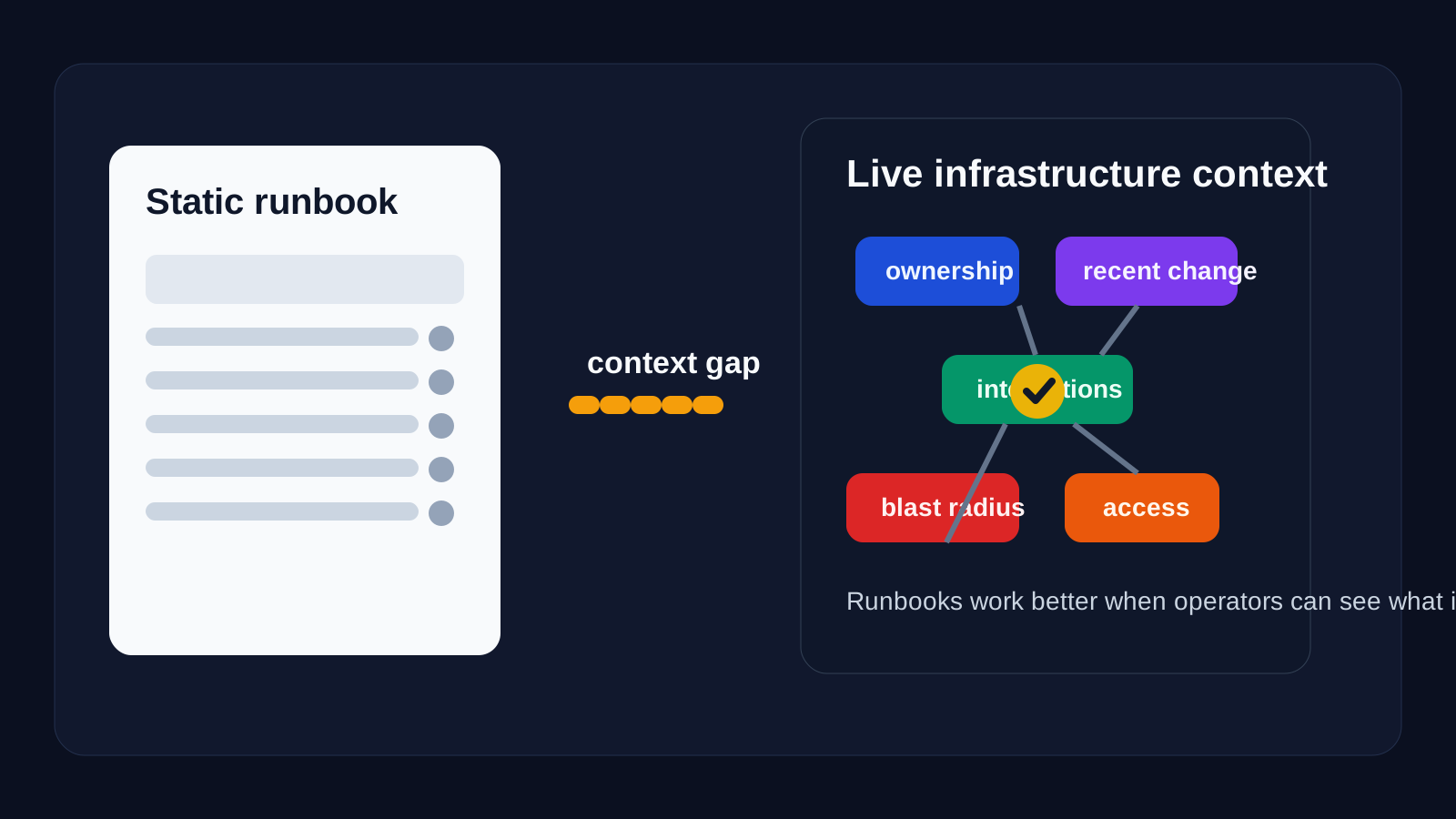
Quick answer: The problem is usually not that your team forgot to write a runbook. It is that, during a real incident, responders still need live context about ownership, recent changes, connected tools, and blast radius before any documented step becomes safe to execute.
TL;DR
- Static runbooks are still useful, but they break down when incidents involve AI-connected systems, fast-moving change, or unclear ownership.
- Modern responders need current context, not just documented procedure.
- The practical bottleneck is often time-to-context: how fast a team can build enough trusted evidence to take the next safe action.
- OpsRabbit fits this gap by helping teams assemble operational context faster when the pressure is on.
What problem are we solving?
A lot of teams already have runbooks for incident response.
They have escalation paths. They have rollback instructions. They have lists of checks to perform. They have pages for suspicious auth events, broken deployments, exposed admin surfaces, and noisy integrations.
And still, during live incidents, the room slows down.
Not because nobody documented the steps.
Because the first real question is usually not “Which runbook do we have?” It is “Can we trust this next action in the environment we have right now?”
That is where AI-era operations get messy.
An incident now might involve an AI coding assistant, an internal workflow agent, an MCP-connected tool, a recently exposed admin path, or a new integration that only a subset of the team fully understands. The runbook may say disable access, rotate credentials, roll back a service, isolate a workload, or block a connector.
But before doing any of that, responders still need to know:
- who owns the affected service today
- what changed in the last deploy or config window
- which external tools or internal agents are connected
- what permissions or tokens are in scope
- whether the symptom is isolated or already spreading
- what action is safest to take first
Without that context, the runbook is real, but it is not yet actionable.
Why this gets worse in AI-heavy environments
AI adoption does not create every incident, but it does increase operational ambiguity.
Microsoft’s recent framing of the agentic SOC is useful here. Their argument is that security teams need more than better alerting. They need evidence assembled faster, likely next steps surfaced sooner, and routine response compressed from hours into minutes so humans can focus on judgment.
That matters because the bottleneck has shifted.
In many cases, the problem is no longer seeing a signal at all. The problem is assembling enough trustworthy context to act without making the situation worse.
That gap expands when environments include:
- AI-connected admin and collaboration tools
- agent workflows that cross team boundaries
- rapid code and configuration change
- unclear ownership of new automations
- security findings that immediately become operations work
Praetorian’s MCP security research makes this concrete. The integration layer that connects AI systems to enterprise tools can become its own attack surface, including risks around tool chaining, data exposure, and deceptive execution paths. Once incidents span those integrations, responders need more than a static checklist. They need a live map of what is actually connected and exposed.
IBM and Ponemon’s 2025 data breach research points in the same direction from a governance angle. Their findings show AI adoption is outpacing access control and policy maturity in many organizations. That is a strong signal that the documentation layer will also drift unless teams actively connect it to operational evidence.
Static runbooks are not useless. They are incomplete.
This is the important distinction.
The answer is not to throw runbooks away.
Runbooks still matter because they encode judgment ahead of time. They reduce panic. They create consistency. They help teams avoid improvising from scratch at the worst possible moment.
But a modern runbook needs a live context layer around it.
Think of it this way:
- The runbook tells you what kinds of action are appropriate.
- Live context tells you whether that action is safe, necessary, and correctly scoped right now.
If a playbook says revoke a credential, you still need to know where it is used.
If a playbook says isolate a workload, you still need to know what customer-facing systems depend on it.
If a playbook says disable an integration, you still need to know whether that breaks incident visibility somewhere else.
If a playbook says roll back a deployment, you still need to know whether the last known good state was actually good.
That is why incident speed increasingly depends on context assembly, not documentation coverage alone.
The practical metric: time-to-context
A useful way to look at this is through time-to-context.
Time-to-context is the time it takes to move from a raw signal to enough trusted operational understanding to take the next safe action.
That usually includes answers to questions like:
- What changed?
- What is affected?
- Who owns it?
- What is connected to it?
- What evidence supports the next move?
Recorded Future’s March 2026 vulnerability landscape is a good reminder of why this matters. Enterprise teams are dealing with a steady stream of actively exploited issues across security, infrastructure, and application tooling. In that environment, response quality depends on knowing which exposures matter in your actual environment, not just which headlines exist.
This is exactly where many runbooks start to wobble. They assume the operator can fill in the missing environmental facts quickly. In reality, that context is often spread across dashboards, internal docs, cloud consoles, chat history, tribal knowledge, and the memory of whoever happens to be online.
What better response looks like
A stronger incident workflow is not “AI instead of runbooks.” It is runbooks backed by live operational context.
In practice, that means responders should be able to get to the following quickly:
- current service and system ownership
- recent deploy, config, or integration changes
- linked infrastructure and adjacent blast radius
- relevant logs, symptoms, and evidence already correlated
- likely next actions with clear operational framing
That is the difference between a document that sounds correct and a response motion that is actually usable under pressure.
Where OpsRabbit fits
OpsRabbit is built around this operational gap.
The point is not to replace every runbook your team has already written.
The point is to help the person in the middle of an incident build enough real context to use those runbooks well.
When responders can see recent changes, ownership, connected systems, and likely next actions in one flow, the runbook becomes much more powerful. It stops being a static artifact and becomes a decision support layer inside real operations.
That is especially useful when the incident touches AI-connected workflows, security findings that spill into production, or new operational surfaces that the team has not fully normalized yet.
Final thought
If your runbooks feel like they are failing more often lately, the issue may not be bad documentation.
It may be that your environment is changing faster than static procedure can keep up.
In AI-era operations, the question is no longer just whether the team has a playbook.
It is whether they can build live context fast enough to trust the next step.
FAQs
Why are static runbooks less effective for AI-era incidents?
Because incidents increasingly involve fast-moving changes, AI-connected tooling, and distributed ownership. Teams still need current operational context before they can safely apply a documented step.
What does live infrastructure context include?
It includes current ownership, recent deploys or config changes, connected tools or systems, access paths, runtime evidence, and likely blast radius.
Sources
- The agentic SOC—Rethinking SecOps for the next decade - Microsoft Security Blog, April 9, 2026.
- MCP Server Security: The Hidden AI Attack Surface - Praetorian, February 17, 2026.
- Cost of a data breach 2025 - IBM and Ponemon Institute, 2025.
- March 2026 CVE Landscape - Recorded Future, March 2026.
Last Updated
2026-04-26
Ready to Transform Your Operations?
Ask for a demo today. Experience how OpsRabbit can reduce your MTTR by up to 90%.