Quick answer: The agentic SOC is a real shift in how security teams investigate and respond, but production incidents still slow down when the people operating systems cannot get service context, ownership, recent changes, and runtime evidence in one place.
TL;DR
- The security industry is moving from alert triage toward AI-assisted and supervised autonomous investigation.
- That is good news, but it does not remove the operational handoff problem.
- Production responders still need fast answers about what changed, what is affected, who owns it, and what to do next.
- The teams that win are the ones that reduce time-to-context, not just alert volume.
What problem are we solving?
The phrase agentic SOC is suddenly everywhere, and for good reason.
Microsoft Security recently described a future operating model where deterministic protections stop high-confidence threats automatically and AI agents assemble evidence so analysts can spend more time on judgment, oversight, and risk. That direction makes sense. If security teams can remove noise and compress investigation time from hours to minutes, everyone benefits.
But there is still a messy middle that most teams know too well.
An incident may start as a security signal, but the moment it touches production, someone still has to answer very practical questions:
- Which services are actually affected?
- What changed in the last deploy window?
- Are the symptoms isolated or spreading?
- Who owns the systems that need action first?
- What should be contained, verified, or rolled back right now?
That is where incidents still bog down.
Short answer
The agentic SOC can make the front half of investigation faster. It does not automatically solve the last-mile operations problem. Teams still need usable incident context across systems, deploy history, service ownership, and live runtime evidence before they can act confidently.
Why this trend matters right now
This is not a hypothetical future-state conversation anymore.
Microsoft says its vision for the agentic SOC combines autonomous disruption with AI agents that pre-assemble evidence and suggest likely next steps. It also reports real operating results, including ransomware disruption in an average of three minutes and internal testing where agents automate a large share of phishing and malware investigations.
At the same time, Google Threat Intelligence Group is reporting that threat actors are integrating AI into reconnaissance, phishing preparation, and malware workflows. In plain terms, attackers are getting faster too.
That means the old playbook of manually stitching together alerts, logs, deploy records, ownership notes, and chat threads gets more painful, not less.
And the cost of slow containment is still real. IBM's Cost of a Data Breach research continues to underline the business value of faster identification and containment.
Where operations teams still get stuck
Here is the part that security strategy diagrams often skip.
Even when detection improves, production response still depends on context assembly.
A security alert may tell you something suspicious is happening. It usually does not tell the responder everything needed to take the next safe action. Someone still has to connect the alert to:
- the services currently running in production
- the most recent config or code changes
- the owners who can validate risk and approve action
- the runtime symptoms that change priority
- the evidence that separates a likely issue from a real incident
If those answers live in different tools, responders lose time while the issue is still unfolding.
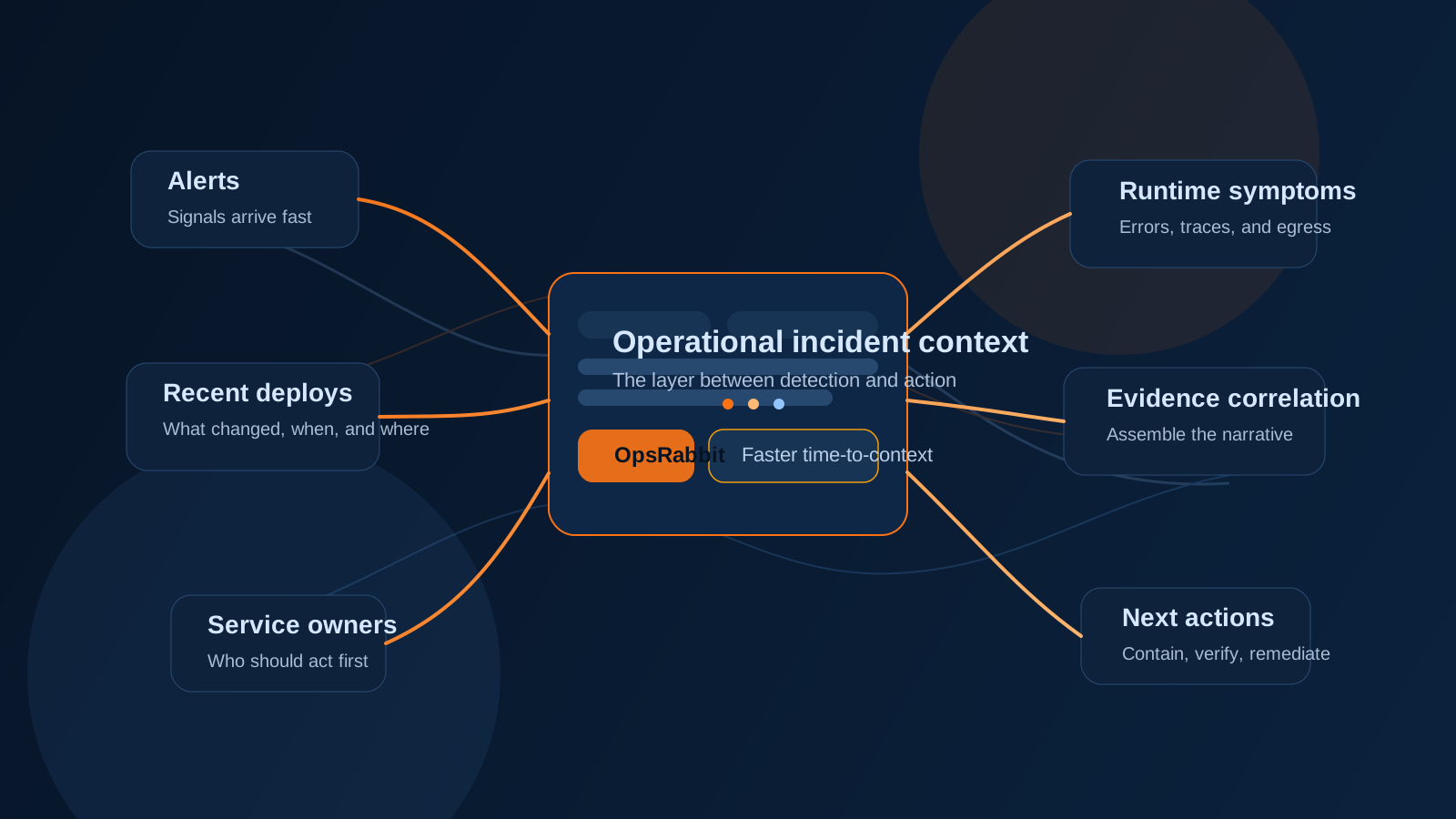
The useful investigation layer is the one that turns scattered evidence into operational context.
The real bottleneck is time-to-context
A lot of teams talk about time-to-detect and time-to-resolve.
Those matter, but there is another metric hiding in between them: time-to-context.
This is the time it takes to go from “something is wrong” to “we know enough to act without making things worse.”
That is usually the longest and most human-fragile part of an incident.
During that window, people are jumping between monitoring tools, deploy systems, docs, chat, tickets, and tribal memory. The process is technically possible, but operationally expensive.
That is also why the agentic SOC conversation should matter to operations leaders, not just security teams. If AI can reduce the cost of evidence collection and correlation, the biggest win is not another dashboard. The biggest win is giving responders a better starting point.
What a useful AI investigation layer should actually do
For operations teams, a helpful AI investigation workflow should be boring in the best possible way. It should make the basics faster and clearer.
That means it should help assemble:
- impacted services and environments
- recent deploys or config changes tied to the timing
- service ownership and likely responders
- correlated symptoms from logs, metrics, traces, and alerts
- a working narrative of what is most likely happening
- the next actions worth validating first
This is what turns AI from an impressive demo into something operationally useful.
Where OpsRabbit fits
OpsRabbit is built for this exact gap.
It is not trying to replace every security platform or pretend all incidents start in the same place. The practical job is simpler and more useful: help responders move from alert to usable production context faster.
That means pulling together the questions teams actually ask in the first minutes of an incident:
- what changed
- what services are involved
- what evidence supports the likely path
- who should respond
- what should happen next
If the industry is moving toward an agentic SOC, this operational layer becomes more important, not less. Faster upstream detection only increases the value of faster downstream context.
Final thought
The agentic SOC is a strong direction. I think the industry is right to move there.
But the teams who actually contain and remediate incidents still need the same thing they have always needed: context they can trust, quickly enough to act.
That is why the operations bottleneck is still context.
If your current incident workflow still depends on people manually piecing together deploy history, ownership, runtime evidence, and next steps during a live issue, that is the gap worth closing.
OpsRabbit exists to help close it.
FAQs
What is the agentic SOC in practical terms?
It is a security operating model where deterministic protections and AI agents reduce noise, assemble evidence, and speed up investigation so humans can focus on judgment and risk.
Why does incident context still matter if AI triages alerts?
Because teams still need to know which services changed, who owns them, what symptoms are visible in production, and what action should happen first.
Sources
- Microsoft Security, The agentic SOC, rethinking SecOps for the next decade - accessed April 15, 2026.
- IBM, Cost of a Data Breach 2025 - accessed April 15, 2026.
- Google Cloud, GTIG AI Threat Tracker - accessed April 15, 2026.
- CISA Cybersecurity Alerts & Advisories - accessed April 15, 2026.
Last Updated
2026-04-15
Ready to Transform Your Operations?
Ask for a demo today. Experience how OpsRabbit can reduce your MTTR by up to 90%.