Quick answer: AI adoption is moving faster than documentation, ownership, and guardrails. When an incident touches an undocumented copilot, workflow agent, or AI-connected admin tool, operations teams often lose the first critical stretch of response just figuring out what is in play.
TL;DR
- Shadow AI is not just a governance problem. It is becoming an incident-response problem.
- The first slowdown is usually not detection. It is context assembly.
- Teams need to know which AI-connected systems exist, what access they have, what changed recently, and who owns them.
- OpsRabbit helps compress that time-to-context so responders can act sooner.
What problem are we solving?
A lot of teams are adopting AI in ways that feel completely reasonable in the moment.
An engineer adds an AI coding assistant. A support workflow gets connected to an LLM. A product team wires an agent into internal documentation. A platform engineer tries a new automation tool that can inspect infrastructure or update configs. None of that sounds dramatic on its own.
The trouble starts later.
Something breaks. A workflow behaves oddly. A configuration changes unexpectedly. Sensitive data shows up in the wrong place. An admin surface is exposed. A downstream service begins failing in a way nobody can explain quickly.
And then the response team runs into a very human problem: they are not sure which AI tools are involved, what permissions those tools have, what changed recently, or who actually owns the thing.
That is the part people tend to underestimate.
Short answer
Shadow AI becomes an ops incident when responders have to spend the first part of a live issue discovering the system before they can investigate the issue.
That means the real bottleneck is often not just alerting, or even triage. It is building enough trusted context to take the next safe step.
Why this matters right now
IBM and Ponemon's 2025 breach research points to two useful realities at once.
First, faster identification and containment materially improve outcomes. Second, AI adoption is outpacing security oversight in a lot of organizations. In other words, the stakes are going up at the same time that governance is still catching up.
Microsoft's recent agentic SOC framing points in the same direction from a different angle. Security operations are moving toward workflows where evidence gets assembled faster and investigation starts earlier. That is good news. But it also raises the bar for the rest of the response process. If the front half gets faster while the ops team still has to hunt through dashboards, change records, and ownership docs to understand the environment, the handoff is still slower than it should be.
Recent vulnerability reporting also reinforces the practical risk. Recorded Future's March 2026 review highlighted high-impact issues across products like Langflow, n8n, and Nginx UI, alongside mainstream enterprise platforms. Not every item on that list is "AI" in the strict sense, but the pattern is clear enough: connected tooling, admin surfaces, and fast-moving integrations can become live response problems very quickly.
CISA's alert and advisory model reflects the same operational reality. When the threat is urgent, teams do not need abstract awareness. They need enough context to mitigate safely.
What the first 20 minutes of a shadow AI incident usually look like
This is usually what responders need to answer before they can do anything with confidence:
- Which AI tool, workflow, or integration is actually involved?
- Is it customer-facing, internal-only, or connected to production controls?
- What data sources, credentials, APIs, or admin paths can it reach?
- Did something change in the last deploy, config push, or prompt workflow?
- Which service owners, platform owners, or security leads need to be pulled in?
- What evidence supports containment, rollback, credential rotation, or escalation?
That list is not glamorous, but it is real.
A surprising number of incidents feel chaotic not because teams lack smart people, but because the necessary context is scattered across too many places.
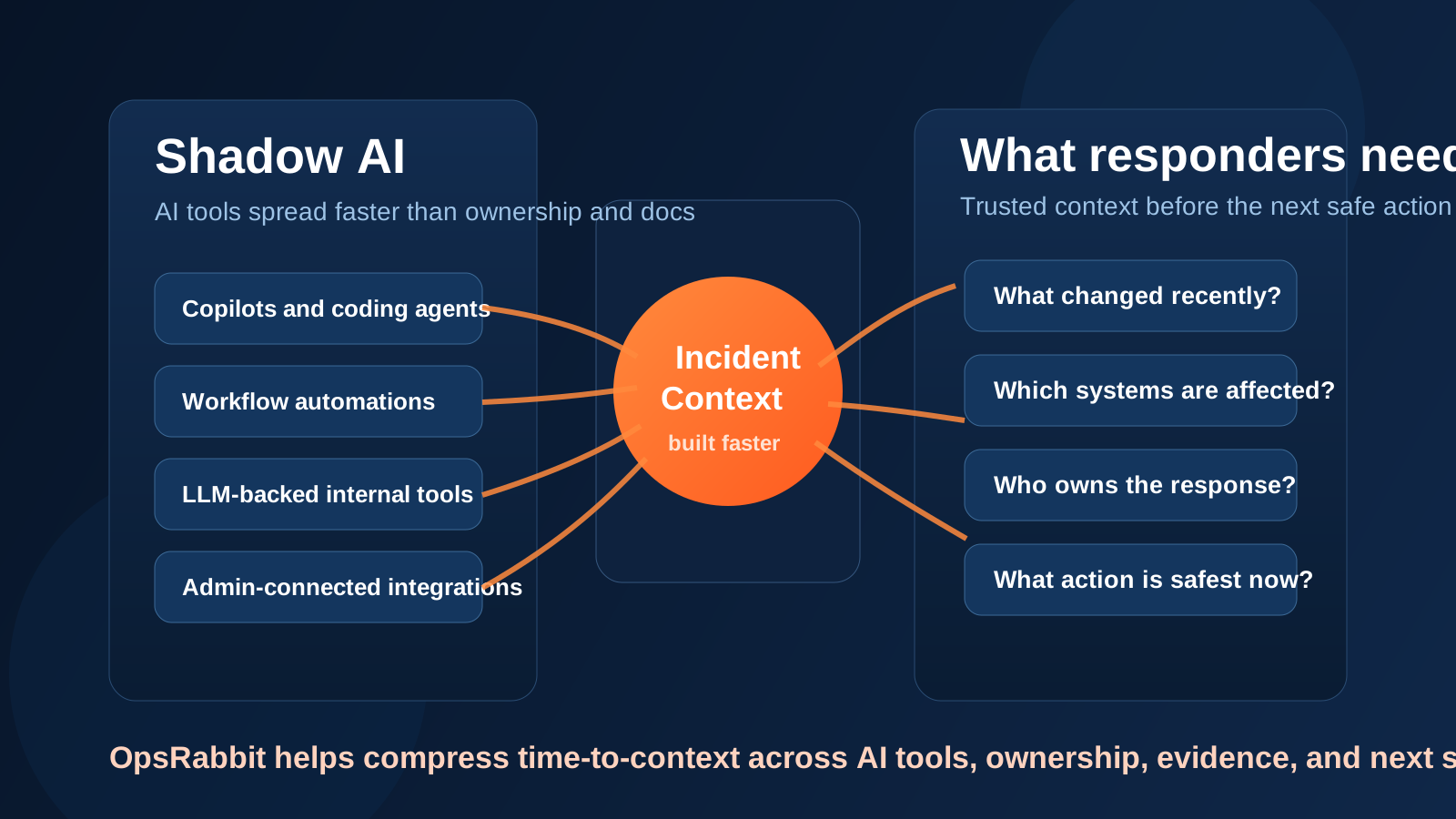
The bottleneck is often not finding the signal. It is assembling the story fast enough to act.
Why governance alone does not solve it
I think governance matters a lot here, but I would not overstate what a policy document can do in a live incident.
A strong AI use policy helps. Asset reviews help. Access controls help. Approval flows help.
But when something is already going wrong, responders still need an operational picture:
- what exists
- what it touches
- what changed
- what is affected
- who can make the next call
That is why this is bigger than compliance language.
The Kubernetes community made a similar point recently when writing about production debugging. Teams often take the fastest path under pressure, like broad access or shared controls, because it gets the immediate job done. The risk shows up later when the environment is harder to reason about and harder to secure. Shadow AI follows a similar pattern. Quick adoption feels efficient until a live incident forces everyone to reconstruct the map.
Time-to-context is the metric hiding in the middle
Most teams already track some version of time-to-detect and time-to-resolve.
Both matter. But there is another operational metric sitting right between them: time-to-context.
Time-to-context is how long it takes to move from a suspicious signal to enough trusted evidence to take the next safe action.
That action might be disabling an integration, rotating a token, rolling back a deployment, isolating a service, or deciding the issue is narrower than it first appeared.
Either way, speed only matters if teams can trust what they are seeing.
For shadow AI incidents, time-to-context often stretches because responders are piecing together SaaS usage, service inventory, logs, access patterns, owners, and recent changes all at once.
Where OpsRabbit fits
This is the exact kind of gap OpsRabbit is meant to close.
OpsRabbit helps teams build usable operational context faster. Instead of treating the incident as a pile of disconnected alerts, it helps responders get closer to the questions that actually matter:
- what changed
- what systems are affected
- who owns them
- what evidence is most relevant
- what next action is safest to validate first
That does not replace governance work. It makes live response more practical when governance is incomplete, the environment is messy, or the incident is moving faster than the documentation.
Final thought
Shadow AI is often described like a policy failure.
Sometimes it is. But in day-to-day operations, it usually shows up as a context failure first.
The team knows something is wrong. They just do not know the full shape of the system quickly enough to respond with confidence.
That is why this matters now.
As AI adoption spreads across engineering, support, operations, and internal tooling, the incident load will not only come from traditional apps and infrastructure. It will also come from the half-documented, loosely governed, highly connected systems people added because they were useful.
The teams that handle this well will not just be the ones with better policies. They will be the ones that can turn scattered signals into trusted operational context fast enough to act.
FAQs
Why is shadow AI an incident-response problem?
Because undocumented AI tools and integrations create confusion during live incidents, forcing responders to spend time discovering ownership, access, and recent changes before they can act.
What does ops context mean for AI incidents?
It means the practical evidence teams need to respond, like service ownership, credentials or integrations in scope, deployment history, logs, affected systems, and next safe actions.
Sources
- Microsoft Security, The agentic SOC, Rethinking SecOps for the next decade - accessed April 20, 2026.
- IBM, Cost of a Data Breach 2025 - accessed April 20, 2026.
- Recorded Future, March 2026 CVE Landscape - accessed April 20, 2026.
- CISA, Cybersecurity Alerts & Advisories - accessed April 20, 2026.
- Kubernetes Blog, Securing Production Debugging in Kubernetes - accessed April 20, 2026.
Last Updated
2026-04-20
Ready to Transform Your Operations?
Ask for a demo today. Experience how OpsRabbit can reduce your MTTR by up to 90%.