Quick answer: In AI-connected incidents, the fastest safe move is usually not a broad lockdown. It is getting enough trusted context to apply temporary, targeted hardening before confusion and blast radius both grow.
TL;DR
- Faster alerts do not automatically create faster incident response.
- Ops teams still need context before they can decide what to disable, isolate, restrict, or roll back.
- Predictive hardening is the habit of applying temporary, targeted controls based on the most likely risk path while investigation continues.
- OpsRabbit helps teams shorten time-to-context so those decisions happen earlier and with less guesswork.
What problem are we solving?
When a modern incident starts, most teams can tell that something is off.
An alert fires. A workflow behaves strangely. A privileged integration does something unexpected. A spike shows up in logs. A security team drops a warning into Slack.
The painful part is what happens next.
Responders still need answers to basic questions before they can act safely:
- What changed?
- Which systems are actually in scope?
- Is this a real attack path or just noisy behavior?
- Which workflow, service, or admin surface is involved?
- Who owns the affected path?
- What is the safest action we can take in the next ten minutes?
That is the gap where incidents lose time.
Short answer
Predictive hardening means applying temporary, evidence-backed controls before you have the full story, but after you have enough context to avoid blind guesswork.
It sits between detection and remediation.
Not panic. Not perfect certainty. Just fast enough understanding to reduce risk safely.
Why this matters now
Microsoft's recent guidance on incident response for AI makes a useful point: the fundamentals still hold, but AI changes the speed of harm, the telemetry teams need, and how responders verify remediation.
That matters for operations because AI-connected systems create more ambiguous incidents.
A responder may not just be looking at one misbehaving host or one obvious exploit. They may be dealing with a chain that includes identity, orchestration, connectors, admin tooling, retrieval layers, policies, or automated actions that touch production systems.
At the same time, Google's latest threat intelligence reporting shows attackers are already using AI to accelerate reconnaissance, phishing preparation, and other parts of the attack lifecycle. In plain language: the environment is getting faster on both sides.
That means the old response pattern breaks down more often:
- Alert appears.
- Humans open five tabs.
- Everyone argues about scope.
- Someone suggests locking everything down.
- Another person says that would break production.
- The first 20 minutes disappear.
That is not a tooling shortage. It is a context shortage.
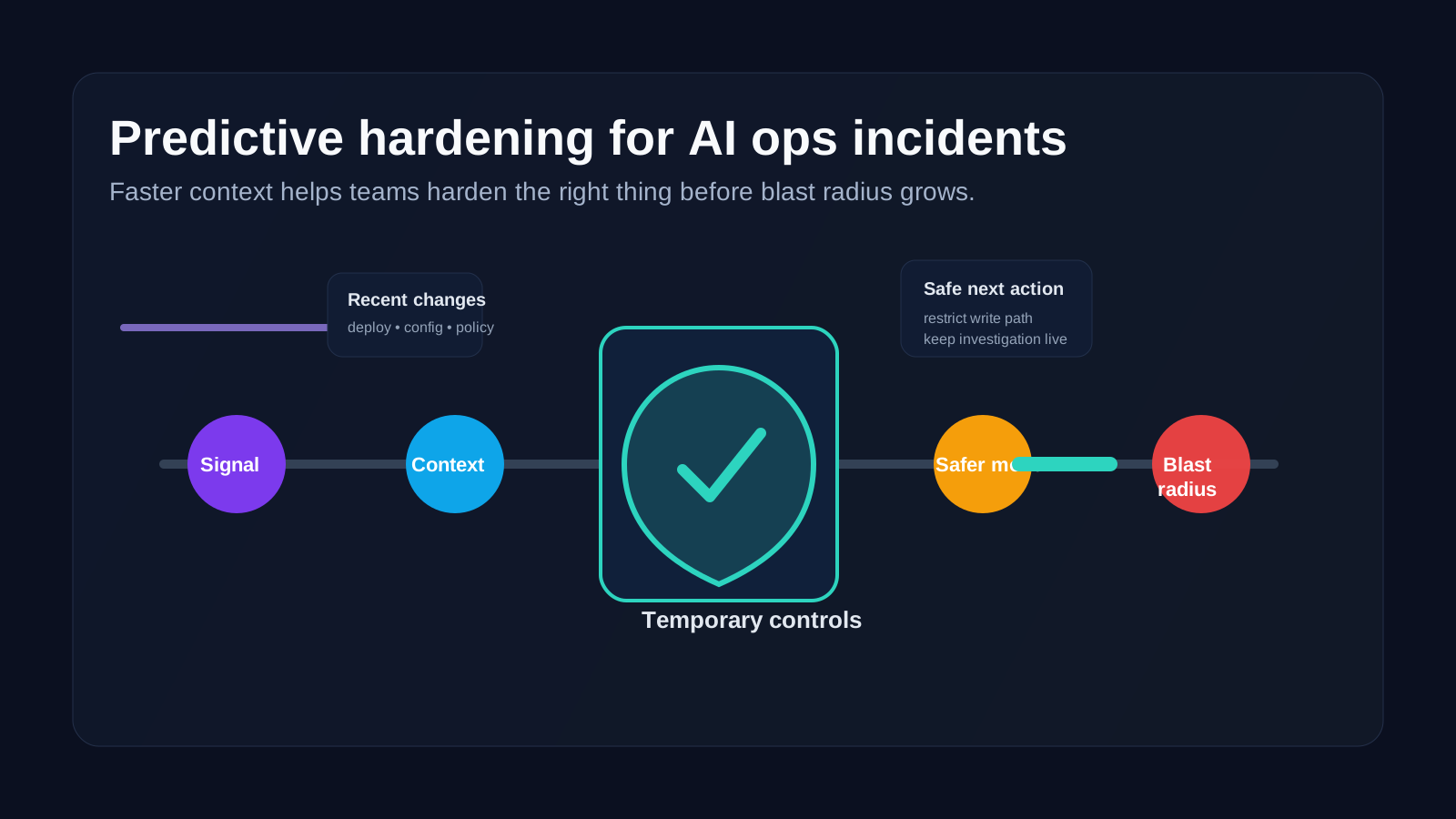
The real advantage is not reacting everywhere at once. It is knowing where temporary hardening will matter most.
What predictive hardening actually means
I like the phrase because it is more practical than a lot of AI security language.
Predictive hardening is not magic. It is not a promise that the system knows everything. It is not permanent lockdown.
It is a disciplined response move:
- infer the most likely path of harm
- verify enough context to trust that inference
- apply temporary controls to slow or stop that path
- keep investigating while the environment is safer
Microsoft's recent case study on predictive shielding is a good example of the pattern. In that incident, the attacker used Group Policy as a likely path for tampering and ransomware distribution. The system applied targeted hardening before the ransomware path fully landed, helping prevent encryption through that route.
The operational lesson matters even if your stack looks nothing like Defender.
The lesson is this: the best early response is often not full remediation. It is temporary, contextual friction placed on the attack path that appears most likely to matter.
Why blanket lockdown usually fails
When teams lack context, they usually swing toward one of two bad options.
Option 1: Wait too long
The team keeps gathering evidence because nobody wants to make the wrong move. That feels careful, but it often leaves the risky path open while the room debates.
Option 2: Lock down too much
Someone disables a broad integration, cuts access too widely, or freezes a workflow without understanding dependencies. That may reduce one risk while creating a fresh outage.
Blanket lockdown feels decisive. In complex environments, it is often just expensive uncertainty.
What teams actually need is enough context to pick the narrowest useful control first.
Examples might include:
- temporarily restricting an exposed admin surface
- pausing a risky automation path
- isolating one integration from write actions
- limiting a service account's permissions
- blocking a suspicious workflow from calling downstream systems
- rolling back a specific recent configuration change
Those are not glamorous moves. They are good moves.
What the first 20 minutes should look like
A stronger incident response pattern usually looks something like this.
1. Confirm the signal
Is this a real incident candidate, a policy violation, a tooling failure, or noisy automation?
2. Assemble decision-grade context
Pull together the few things that matter most first:
- recent changes
- affected services
- likely owners
- suspicious actions
- relevant telemetry
- exposed control planes or workflows
3. Identify the most likely risk path
Where can harm spread fastest?
That could be a privileged integration, a deployment path, an identity route, an orchestration layer, or a configuration plane.
4. Apply the narrowest temporary hardening that reduces risk
This is the predictive hardening move.
Not forever. Not everywhere. Just enough to reduce risk while preserving room to operate.
5. Keep building the incident story
Temporary controls buy time. They do not replace understanding.
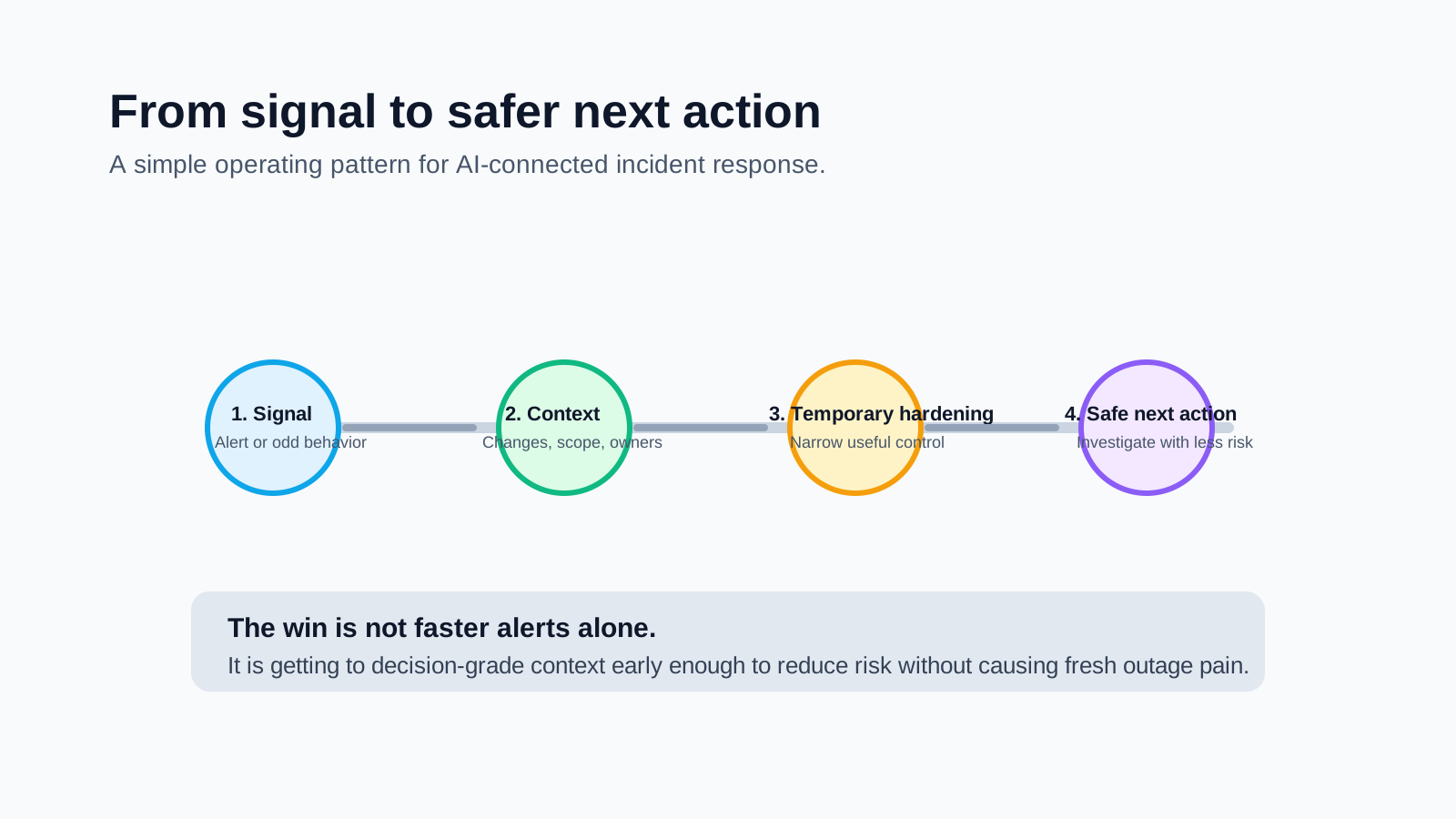
The operational win is moving from suspicious signal to safer next action without losing the story.
Time-to-context is still the hidden metric
This is really an extension of the same problem many ops teams already feel.
Detection is visible. Resolution is visible. The biggest delay often lives in the middle.
That middle is time-to-context: how long it takes to move from "something is wrong" to "we know enough to take the next safe step."
If time-to-context is slow, predictive hardening is slow too.
If time-to-context is fast, teams can contain earlier without swinging blindly.
That is why the context layer matters so much in AI-connected incidents. These environments produce more signals, more possible dependencies, and more ways for one bad action to spread across systems.
Where OpsRabbit fits
OpsRabbit is built for this exact middle layer.
Not as another noisy dashboard. Not as a vague "AI for ops" promise.
The practical job is to help responders answer the questions they actually ask under pressure:
- what changed
- what is in scope
- who owns it
- what evidence matters most
- what next action is safest to try first
That is what makes predictive hardening possible in real operations.
You cannot apply smart temporary controls if the team is still guessing about ownership, blast radius, or the most likely attack path.
OpsRabbit helps compress that uncertainty.
Final thought
I think a lot of incident response discussion still treats the first decision as a choice between doing nothing and doing everything.
That is usually the wrong frame.
The better frame is this:
How quickly can we understand enough to harden the right thing temporarily?
That is where good operations teams win.
Not by being reckless. Not by waiting for perfect certainty. But by getting to decision-grade context fast enough to reduce risk before the incident gets a vote.
If your team is dealing with AI-connected workflows, admin surfaces, and operational incidents that move faster than humans can manually stitch together, it is a good time to evaluate how much time-to-context is costing you.
FAQs
What is predictive hardening in incident response?
It is the practice of applying temporary, targeted controls based on the most likely risk path once responders have enough trusted context to reduce risk safely.
Why not just lock everything down immediately?
Because broad lockdowns can create new outages or break critical workflows. Teams need enough context to choose the narrowest useful control first.
Sources
- Microsoft Security, Incident response for AI: Same fire, different fuel - accessed April 28, 2026.
- Microsoft Security, The agentic SOC—Rethinking SecOps for the next decade - accessed April 28, 2026.
- Microsoft Security, Case study: How predictive shielding in Defender stopped GPO-based ransomware before it started - accessed April 28, 2026.
- Google Threat Intelligence Group, GTIG AI Threat Tracker: Distillation, Experimentation, and (Continued) Integration of AI for Adversarial Use - accessed April 28, 2026.
- IBM, Cost of a Data Breach 2025 - accessed April 28, 2026.
Last Updated
2026-04-28
Ready to Transform Your Operations?
Ask for a demo today. Experience how OpsRabbit can reduce your MTTR by up to 90%.