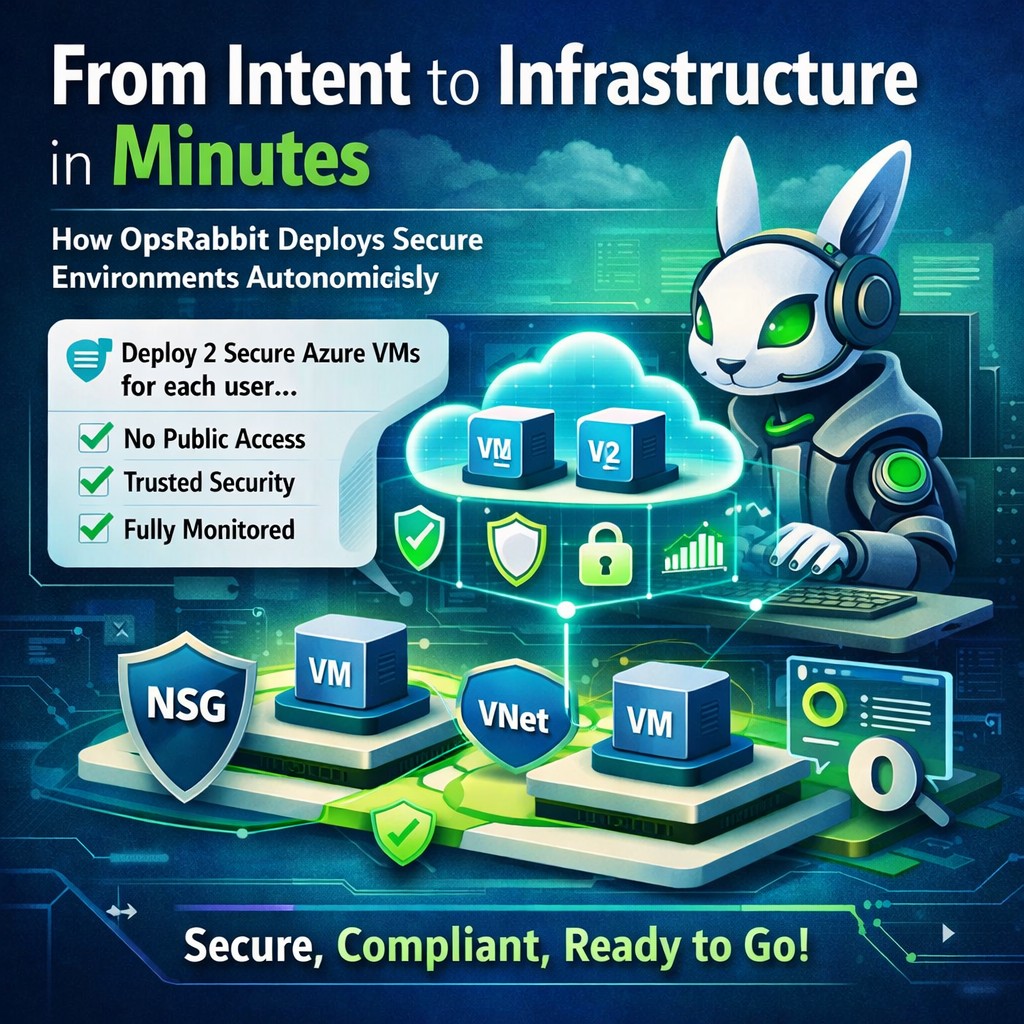
Quick answer: OpsRabbit converts infrastructure intent into governed Azure deployment steps automatically, reducing manual ticketing and configuration drift risk.
The Ask: Simple on the Surface
A user needed:
- 2 Azure VMs
- One per user
- Secure, isolated, no public exposure
On paper, that sounds simple.
In reality, behind those three lines live decisions about networking, security, governance, monitoring, and compliance — the exact places where fragile templates and hand-written runbooks tend to break.
The Shift: Conversation → Deployment
Instead of tickets and backlogs, this started as a conversation.
Requirements evolved in real time:
- Windows VMs
- Shared subnet
- No public RDP/SSH
- Strict NSG rules
- Trusted Launch
- Azure Monitor
- Naming convention compliance
OpsRabbit captured those constraints as intent and translated them into a deployable Azure architecture — instantly.
What Was Built
Core Infrastructure
- Resource Group
- Virtual Network
- Shared Subnet
- Network Security Group
Compute
- 2 Windows VMs (Standard_B2s)
- No public IPs
Networking
- Outbound internet allowed where needed
- Inbound blocked by default
- VM-to-VM traffic restricted
Security
- Trusted Launch
- Secure Boot + vTPM enabled
- Disk encryption
- Managed Identity
- Antimalware
Observability
- Log Analytics
- Azure Monitor Agent
- Boot diagnostics
Governance
- RBAC with least-privilege access
- Azure Policies applied
- Resource locks on critical resources
Within minutes, both VMs were running, fully secured, monitored, and governed — with no public exposure.
All from a single interaction.
Security by Default, Not as an Afterthought
Most teams start with “just get it working” and try to retrofit security later.
This environment started from the opposite direction:
- No public endpoints
- Identity-first access via Azure AD and managed identities
- Policy enforcement baked in from day one
Even trade-offs (for example, when to allow outbound access for specific services) were made explicit and documented as part of the deployment plan rather than hidden in ad-hoc firewall rules.
What This Changes for DevOps and Platform Teams
The Old Way
- Tickets and handoffs between teams
- Long lead times for “simple” requests
- Drift between environments and documentation
- Security reviews that happen too late
The OpsRabbit Way
- Intent → Execution: You describe what you need in natural language; the system designs and deploys the environment.
- Unified control: Networking, security, observability, and governance are treated as one design problem, not separate checklists.
- Built-in security: Guardrails and policies are enforced up front rather than patched in after something goes wrong.
For DevOps leaders and platform teams, this means less time on repetitive provisioning work and more time on higher-leverage platform design.
From One-Off Requests to Repeatable Patterns
The most important part isn’t that OpsRabbit can stand up two secure Azure VMs.
It’s that the entire flow — from intent capture to architecture to deployment — becomes a reusable pattern:
- The conversation becomes a specification.
- The specification becomes infrastructure-as-code.
- The infrastructure is deployed with observability and security attached by default.
- The pattern can be reused, adapted, and governed centrally.
Over time, these patterns form a library of safe, opinionated building blocks that teams can request conversationally and deploy confidently.
Final Thought
Infrastructure is no longer something you painstakingly assemble, template by template and script by script.
It’s something you describe.
And OpsRabbit builds it — secure, observable, and production-ready — in minutes.
Ready to Transform Your Operations?
Ask for a demo today. Experience how OpsRabbit can reduce your MTTR by up to 90%.