Quick answer: modern incidents do not always fail because teams missed the first alert. They fail because responders cannot quickly tell whether they are looking at one attacker, one noisy copycat, or two overlapping operators inside the same environment.
TL;DR
- Microsoft's June 22 incident report showed two unrelated threat actors operating inside one intrusion.
- Legitimate tools like remote tunnels, forensic utilities, and admin access paths make the picture harder to separate.
- The first response bottleneck is usually not detection. It is time-to-context.
- OpsRabbit helps teams build one working story faster when the evidence is scattered.
What problem are we solving?
Most incident rooms still begin with a simple mental model.
One alert. One root cause. One attacker story.
That model is comforting, but it breaks fast when the environment contains overlapping access paths, mixed objectives, and tooling that looks half-legitimate from the outside.
In those moments, responders are not really arguing about the alert. They are arguing about the story behind it.
Short answer
Shared incident context matters because a modern intrusion can contain parallel activity that does not fit one clean narrative. If responders cannot quickly separate identities, tools, persistence paths, and likely objectives, they lose time and make containment choices with partial evidence.
Why this matters now
Microsoft's June 22, 2026 DART case study is unusually clear on this point.
The report describes a ransomware-linked investigation where responders uncovered a second, unrelated threat actor operating in parallel inside the same environment. The activity blended legitimate tools, identity abuse, persistence channels, and defense evasion in a way that made the intrusion harder to interpret through isolated signals alone.
That detail matters.
The scary part is not only that multiple actors were present. It is that their activity masked each other and complicated attribution, scope, and response timing.
That is a very practical operations problem.
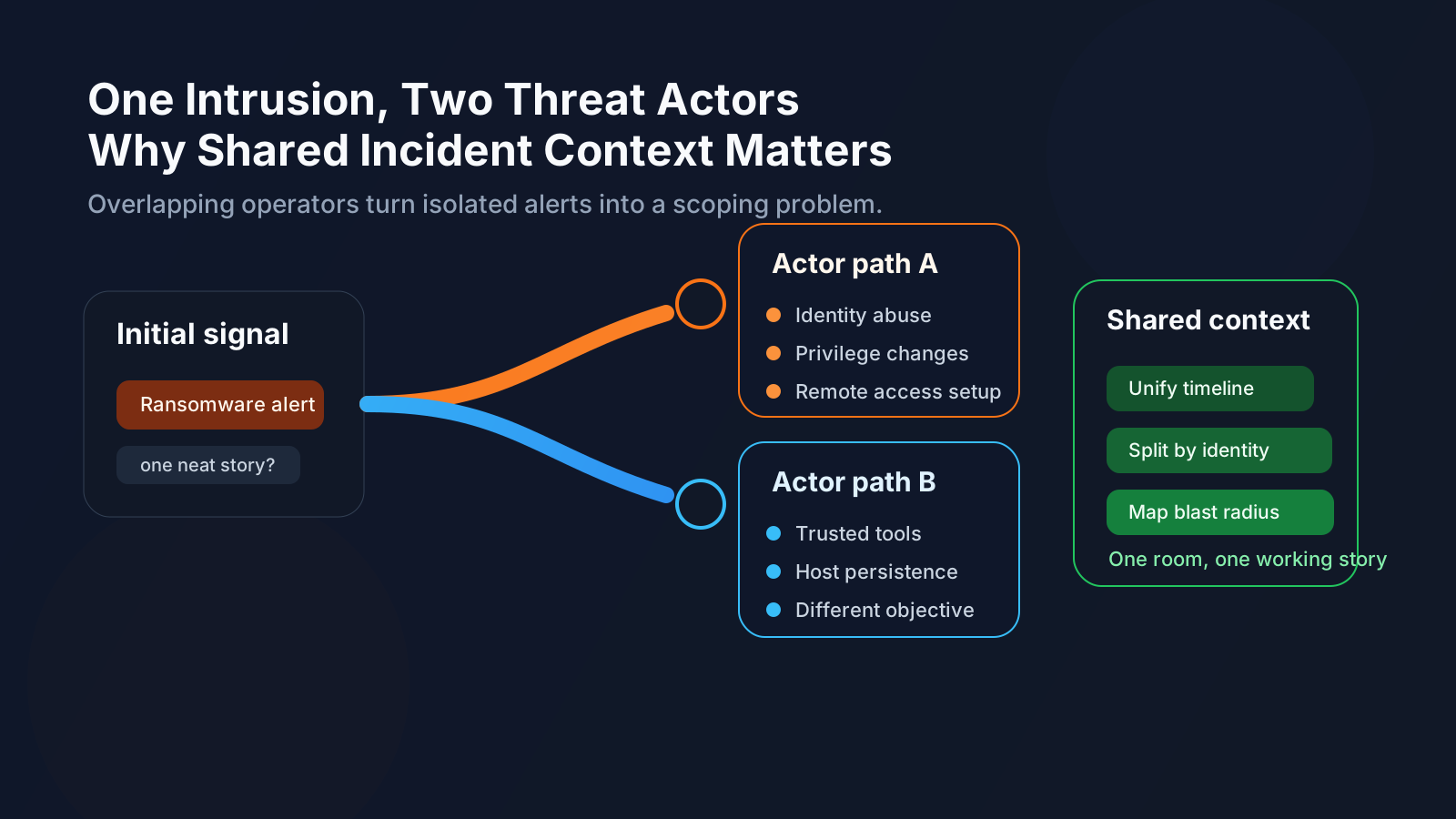
One incident can hide more than one operator story. The response gap is usually context, not raw signal volume.
Why one intrusion can contain more than one story
There are a few reasons this happens.
First, attackers increasingly use legitimate admin pathways instead of obviously malicious tooling.
In the Microsoft case, the activity included tools and channels like Velociraptor, Cloudflare tunneling, Zoho Assist, and SSH configured through Visual Studio Code. None of those names, by themselves, explains intent.
Second, once identity abuse enters the picture, the same environment can support very different access patterns at the same time.
Third, MITRE's guidance on trusted binary proxy execution is a reminder that defenders should expect malicious behavior to hide inside familiar process trees and signed tooling, not only inside cartoonishly bad malware.
Put simply, modern incidents are harder to read at a glance.
Why incident teams get stuck
Most teams can eventually gather the needed evidence.
The problem is the first hour.
That hour often looks like this:
- one person is following suspicious accounts
- one person is looking at endpoint artifacts
- one person is checking remote access tools
- one person is trying to map cloud changes
- someone else is asking whether this is all the same actor
Everyone is working. Nobody has the same picture yet.
That is the real drag on response quality.
What to do in the first hour
If the activity looks blended or inconsistent, assume the story may be incomplete.
1. Build one timeline first
Do not start with three disconnected mini-investigations.
Start with one shared timeline of:
- initial access signals
- identity events
- remote access and tunneling activity
- privilege changes
- host-level persistence
- cloud or SaaS control-plane changes
You are trying to see whether the activity clusters together or forks.
2. Separate evidence by identity and access path
Do not group everything under one hostname or one alert family.
Group by:
- identity used
- tool or channel used
- host touched
- privilege level
- likely objective
This is often where a "single campaign" starts to look more like overlapping operator behavior.
3. Treat legitimate tools as investigation pivots
The right question is not "why is Velociraptor installed?" or "why is there a Cloudflare tunnel?"
The better question is:
- who initiated it
- when it appeared
- what system it touched
- whether it aligns with approved workflows
- what other evidence surrounds it
Context turns a trusted tool from noise into signal.
4. Contain on confidence, not on neat attribution
Microsoft's broader response framing is right here: containment-first discipline still matters.
You do not need perfect attribution before isolating a compromised identity, disabling a suspicious remote path, or tightening privileged access.
What you do need is enough trusted context to avoid containing the wrong thing while the real access path stays open.
5. Keep one working narrative
This sounds obvious, but it is where teams fall apart.
If different responders are operating from different stories, escalation gets messy fast. Ownership blurs. Updates become contradictory. The next safe action becomes a debate instead of a decision.
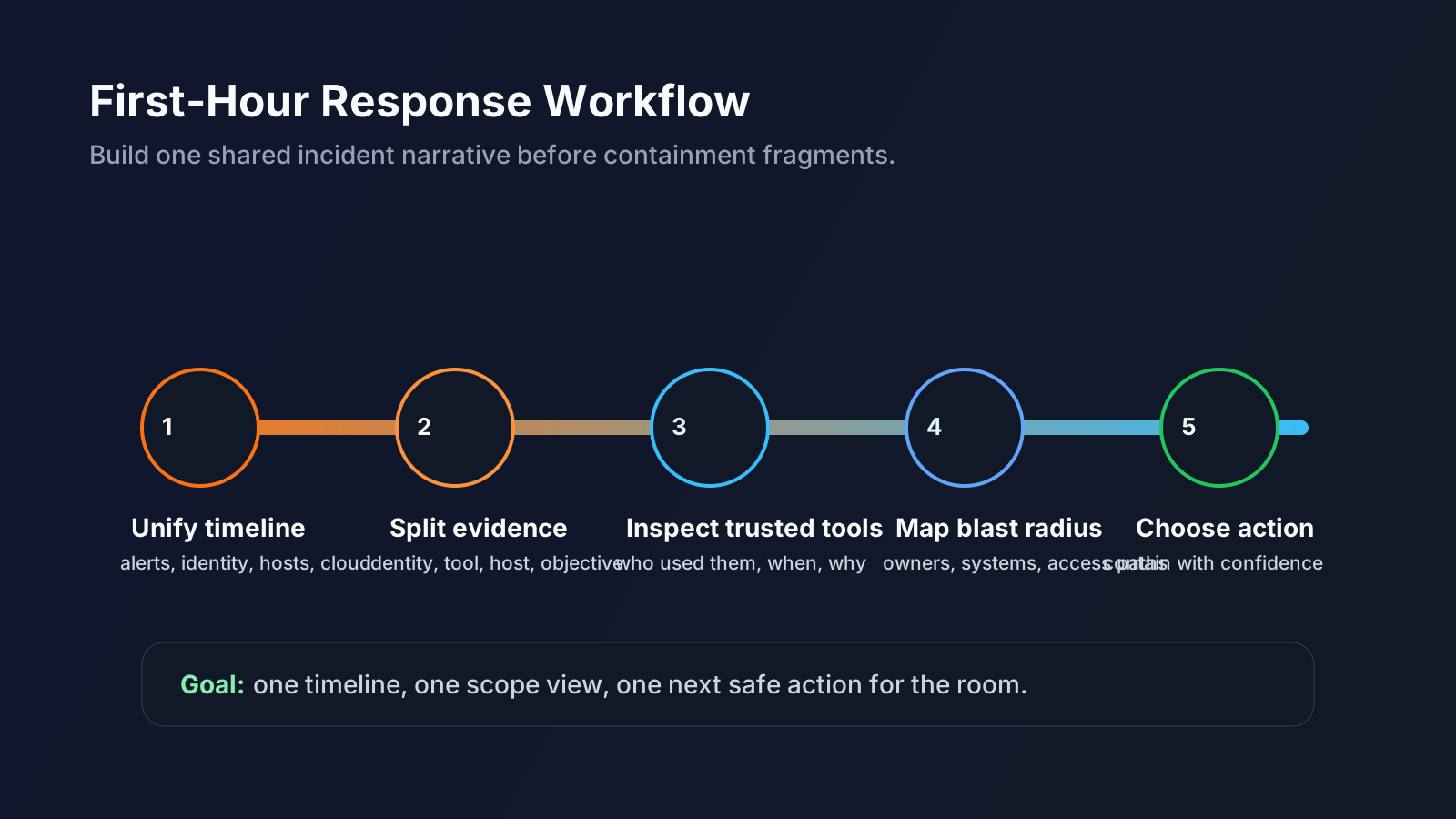
The first hour should converge on one timeline, one scope view, and one next-action decision path.
Where OpsRabbit fits
OpsRabbit is useful here because it shortens time-to-context.
When an intrusion stops looking like one clean story, responders need a faster way to assemble:
- impacted systems and owners
- recent identity and access changes
- suspicious tools and remote channels
- correlated endpoint and cloud evidence
- the most credible next actions
That does not replace your security tools.
It helps the room stop thrashing between them.
Final thought
The biggest lesson from Microsoft's parallel-activity case is not "every intrusion has two actors."
It is this:
incident rooms that assume one neat story for too long lose time.
The teams that respond well will be the ones that can quickly ask:
- which evidence clusters belong together
- which identities matter most
- which trusted tools are expected versus suspicious
- what we know well enough to contain right now
That is shared incident context. And it is becoming operationally non-negotiable.
If your team wants a faster way to build one usable story across messy incidents, it is a good time to look at OpsRabbit.
FAQs
Why is shared incident context important in incident response?
Because responders often see fragmented signals first, and they need one coherent view across identities, endpoints, cloud activity, and remote access paths before they can contain safely.
Does multiple threat activity always mean multiple attackers?
No. But responders should avoid assuming one clean storyline too early when the evidence clusters do not line up.
Sources
- One intrusion, two cyberattackers: Uncovering parallel threat activity - Microsoft Security Blog, June 22, 2026.
- Incident response for AI: Same fire, different fuel - Microsoft Security Blog, April 15, 2026.
- System Binary Proxy Execution, Technique T1218 - MITRE ATT&CK, accessed June 29, 2026.
Last Updated
2026-06-29
Ready to Transform Your Operations?
Ask for a demo today. Experience how OpsRabbit can reduce your MTTR by up to 90%.