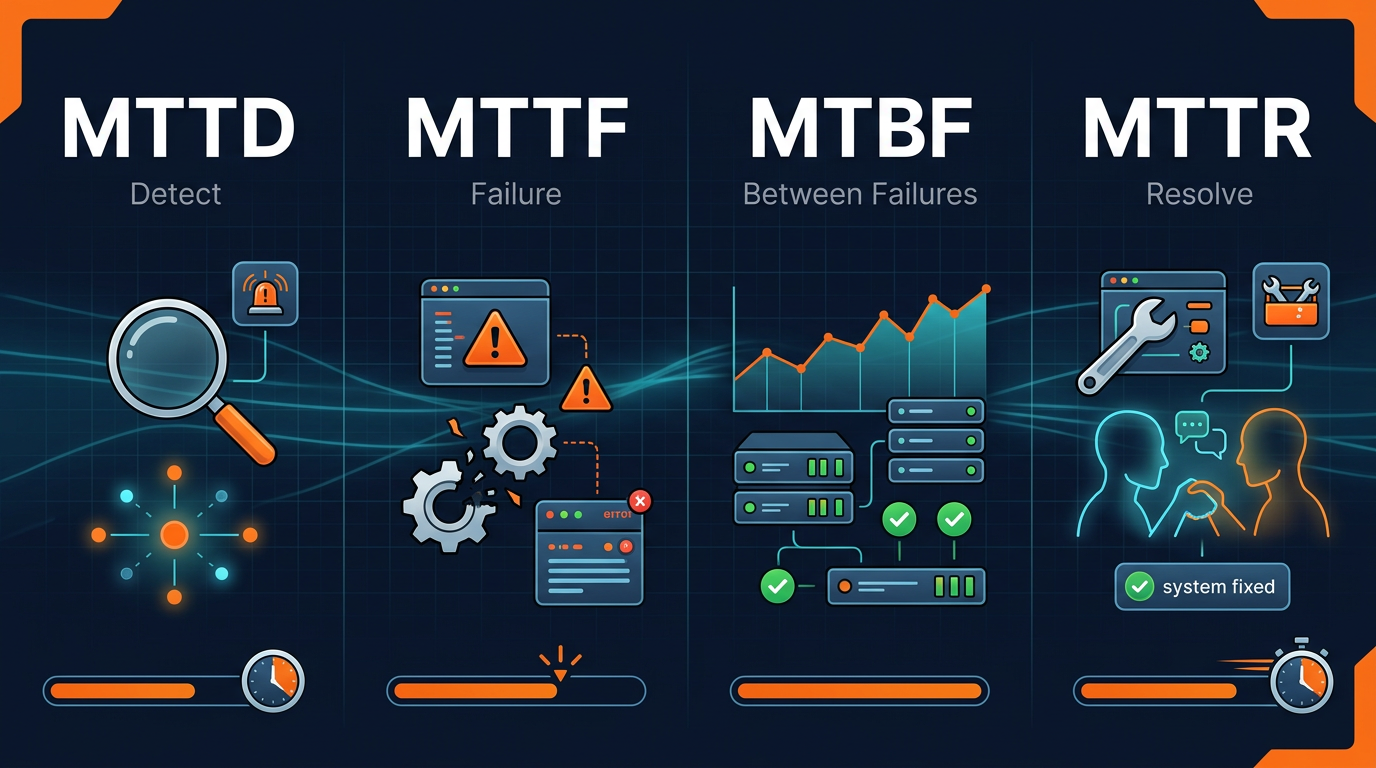
Quick answer: MTTD, MTTF, MTBF, and MTTR measure detection, reliability, and recovery speed; OpsRabbit improves outcomes by accelerating investigation context and actionable response.
If your team ships software quickly but still feels blind during incidents, you are not alone.
Mean time to detect (MTTD), mean time to failure (MTTF), mean time between failures (MTBF), and mean time to resolve (MTTR) are some of the most common ways DevOps and SRE teams measure how well they respond to reality. Used together, they tell a story: how fast you notice problems, how often things break, how reliable components are, and how long it takes to get back to healthy.
This post explains each metric in plain language and shows where OpsRabbit—AI for ITOps from OpsRabbit.io—fits in.
Why these four metrics still matter in 2026
Modern stacks generate more telemetry than any human can read during an outage. Metrics without a workflow become vanity numbers.
Teams that track MTTD and MTTR with discipline can see whether tooling and process changes actually help. MTBF and MTTF anchor longer-horizon reliability and capacity conversations—especially for components where failure is expensive or irreversible.
OpsRabbit is built for the part of the journey where minutes matter: turning alerts and siloed data into a coherent investigation so your people spend less time hunting and more time fixing.
Mean time to detect (MTTD)
MTTD is the average time between when a problem starts affecting the system (or users) and when your team knows something is wrong.
Long MTTD usually means noisy monitoring, weak correlation, or gaps between “symptom” and “ownership.” The incident may be real long before the right person sees a useful signal.
How OpsRabbit helps improve MTTD
- Context from the first alert: OpsRabbit ingests alarm context and enriches it with relevant signals instead of waiting for manual triage.
- Parallel data gathering: Specialized agents pull logs, metrics, change history, and dependencies in parallel—so “we have a clue” arrives sooner than serial dashboard hopping.
- Less alert fatigue, faster recognition: By correlating related evidence, teams spend less time deciding whether something is an incident and more time on what it is.
Faster detection does not replace good monitoring architecture—but it compresses the gap between “something broke” and “we are investigating the right thing.”
Mean time to failure (MTTF)
MTTF is typically used for non-repairable components: the average time until a unit fails and is replaced (think of certain hardware or disposable parts). In some organizations the term is used more loosely; align definitions with your engineering and finance partners.
OpsRabbit does not manufacture hardware—but it informs reliability programs that influence how long components and services survive in production.
How OpsRabbit supports MTTF-related outcomes
- Change and failure awareness: Incidents often follow releases, config drift, or dependency shifts. OpsRabbit ties investigations to recent changes (commits, deploys, infra) so teams see patterns that shorten effective component life.
- Feedback into design: When post-incident reviews consistently point to the same class of failure, that data supports better design, testing, and replacement strategy—upstream of the next outage.
Think of OpsRabbit as accelerating organizational learning so MTTF discussions are grounded in evidence, not anecdote.
Mean time between failures (MTBF)
MTBF measures the average operating time between failures for a repairable system or service. Higher MTBF generally means the system is available and stable for longer stretches between incidents.
Improving MTBF is rarely one tool—it is culture, architecture, capacity, and operational discipline. Incident tooling helps when it makes each failure cheaper to understand and less likely to repeat.
How OpsRabbit helps teams push MTBF in the right direction
- Repeatable investigations: Similar incidents surface similar evidence paths. OpsRabbit helps teams recognize recurring failure modes instead of treating every fire as novel.
- Service knowledge graph: Understanding dependencies and blast radius reduces accidental changes that trigger cascading failures—fewer surprise outages, longer calm between storms.
- Shorter recovery loops: When MTTR drops (see below), the service returns to a “good” state faster, which supports higher perceived availability and more productive MTBF conversations.
Mean time to resolve (MTTR)
MTTR (mean time to resolve / repair) is the average time from when a failure is recognized until the service is restored—or the incident is fully mitigated to agreed levels.
This is where cost and customer impact show up most directly. Industry discussion often ties downtime to significant business cost; whether your number is five figures or seven per hour, minutes in the dark add up.
How OpsRabbit improves MTTR
OpsRabbit is explicitly built to shrink the investigation phase—the part where engineers stare at logs, tickets, and charts trying to build a theory.
- From long manual RCA to minutes: OpsRabbit.io positions the product around dramatically faster investigation—collecting contextual evidence and suggested next steps so humans act instead of searching.
- Dynamic investigation plans: Instead of static runbooks that fall behind AI-assisted development, the system adapts the plan to the incident type and what it has already learned from your environment.
- Evidence-backed recommendations: Suggestions come with supporting context (logs, metrics, changes, dependencies), not generic advice—so approvals and fixes move faster.
- Works where teams already collaborate: Integrations with Slack, Microsoft Teams, Jira, ServiceNow, PagerDuty, and common observability stacks mean resolution workflows stay in familiar channels.
Lower MTTR is the metric OpsRabbit is most directly aligned with—while also feeding the data habits that improve MTTD and long-term MTBF.
Quick reference: metrics and OpsRabbit’s role
- MTTD — Time until the team detects the issue. OpsRabbit: faster enrichment, correlation, and parallel signal gathering.
- MTTF — Time until non-repairable failure (strict definition). OpsRabbit: better visibility into change- and load-related failure patterns for planning and design feedback.
- MTBF — Time between failures for repairable systems. OpsRabbit: repeatable investigations, dependency awareness, fewer “mystery” repeats.
- MTTR — Time to resolve. OpsRabbit: AI-driven investigation, SKG-aware analysis, and actionable RCA in the collaboration tools you already use.
Putting it together
You do not need dozens of KPIs on a wall. You need a small set you trust—and tooling that makes the numbers move for the right reasons.
OpsRabbit helps ITOps, DevOps, and SRE teams detect sooner, investigate faster, and carry lessons forward—the levers that show up in MTTD, MTTR, and the reliability story behind MTBF and MTTF.
Learn more about features, integrations, and early access at opsrabbit.io.
Ready to Transform Your Operations?
Ask for a demo today. Experience how OpsRabbit can reduce your MTTR by up to 90%.