Quick answer: if your team mainly needs to deliver read-only tools or artifacts into a pod, Kubernetes image volumes are a safer fit than hostPath because they avoid exposing part of the node filesystem just to get content into the workload.
TL;DR
- hostPath is still useful in edge cases, but Kubernetes explicitly warns that it carries significant security risk.
- Image volumes let teams mount OCI-packaged content into a pod as read-only, which is a much cleaner pattern for many debugging and artifact-delivery scenarios.
- This is a safer default, not a complete security solution. Teams still need least privilege, short-lived access, and clear incident workflows.
- OpsRabbit helps teams compress time-to-context when a Kubernetes runtime or debugging change starts causing confusion under pressure.
What problem are we solving?
Production debugging often runs on a bad compromise.
A responder needs to inspect a workload, mount a tool, or get reference content into a pod quickly. The shortcut is usually to widen access: more permissions, broader mounts, or direct visibility into the node.
That works right up until it becomes part of the incident.
Kubernetes has been blunt that hostPath is risky. Mounting host filesystems into pods can expose privileged APIs, runtime sockets, credentials, or other node-level surfaces that should not be casually reachable from an application container.
The problem is not that teams enjoy taking that risk. The problem is that production pressure rewards the fastest path, even when it quietly expands blast radius.
Short answer
Kubernetes image volumes are safer than hostPath for debugging when the real need is read-only artifact delivery, not host access. They let teams mount OCI-packaged content into a pod without turning node filesystem visibility into the default answer.
Why this matters now
This is newly practical, not just theoretically better.
Kubernetes documents image volumes as stable in v1.36, and the feature is usable on clusters from v1.31 onward when the container runtime supports it. Kubernetes also documents that subPath and subPathExpr support for image volumes is available from v1.33, which makes the feature much easier to use in real workloads.
That matters because many platform teams do not actually need host access for the task in front of them. They need a cleaner way to bring in:
- debug tools
- static scripts
- known-good reference files
- support artifacts packaged in an OCI image
Image volumes change that conversation.

The safer pattern starts when teams stop confusing artifact delivery with node access.
What image volumes change
Image volumes mount content from an OCI image or artifact into a pod as a read-only volume.
That gives teams a better answer to a very common need: “make this content available inside the workload without touching the node filesystem.”
Compared with hostPath, that is a meaningful improvement because:
- the mounted content is read-only
- the delivery unit is an OCI artifact teams can version and review
- the workflow no longer assumes direct visibility into node paths
- responders can reason more clearly about what was introduced into the pod
This is exactly the kind of smaller architectural decision that pays off later during incident response.
Deep dive
A useful way to think about the tradeoff is this: hostPath answers the question "how do I reach the node from this pod?" while image volumes answer a narrower and often safer question: "how do I get this packaged content into the pod as read-only data?"
That narrower question is usually the better one.
If a responder mainly needs a bundle of scripts, a known-good config snapshot, or a diagnostic toolset, image volumes keep the implementation closer to the real need. The pod gets the artifact. The node stays out of the picture. That is cleaner for review, cleaner for change control, and cleaner for incident analysis later.
What image volumes do not solve
This is the part worth being honest about.
Image volumes do not replace RBAC. They do not replace short-lived credentials. They do not replace just-in-time approvals. They do not stop a team from making bad decisions with other permissions.
Kubernetes' recent secure production debugging guidance points in the same direction: safer operations come from least privilege, short-lived identity-bound credentials, and a just-in-time access model instead of broad standing access.
So the right framing is not “image volumes solve production debugging security.” It is “image volumes remove one risky shortcut from the path.”
That is still valuable.
Why hostPath still becomes an ops incident
The first problem during an incident is rarely the YAML field by itself. It is the context gap around it.
When a workload behaves strangely after a runtime or debugging change, the responder needs to answer a familiar set of questions fast:
- which workloads use this pattern
- whether the change was recent
- which team owns the affected service
- whether the issue is in the workload, the mounted artifact, or the access path
- what the safest next step is
That is where platform teams lose time.
Even a safer feature only helps so much if the response still begins with five people hunting through manifests, repo history, cluster state, and Slack threads.
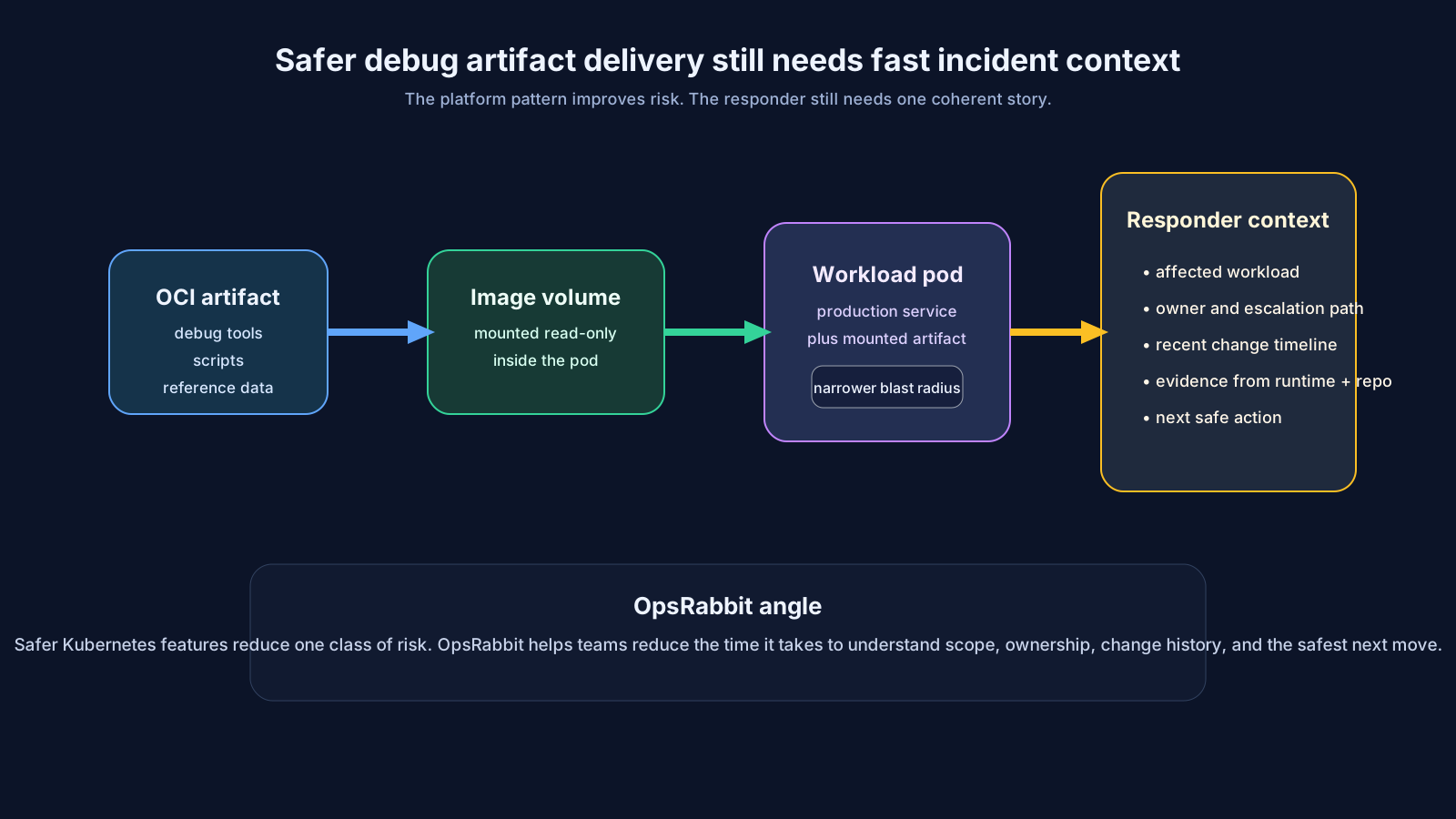
Safer runtime patterns help, but responders still need one coherent story before they can move confidently.
Where OpsRabbit fits
OpsRabbit is useful in that messy first phase.
When a Kubernetes workflow changes or a debugging path starts causing uncertainty, teams need a fast incident picture:
- what changed
- what workloads and services are in scope
- who owns them
- what evidence matters most
- what next action is safest to validate first
That is the time-to-context problem.
OpsRabbit helps teams build that context faster, so the value of safer platform patterns is not lost in slow incident understanding.
Practical takeaway
If your team is still using hostPath mainly to deliver read-only debug content or static tooling into pods, image volumes are worth adopting as the better default.
Not because they are magic. Because they are cleaner. Because they reduce one unnecessary exposure. Because they make it easier to reason about what is actually being mounted into the workload.
That is the kind of improvement operators should like: small enough to implement, meaningful enough to reduce risk, and practical enough to matter in the middle of a real incident.
FAQs
When are image volumes a better choice than hostPath?
When the goal is to mount read-only tools, scripts, or reference artifacts into a pod, not to access the node filesystem itself.
Do image volumes replace Kubernetes access controls?
No. Teams still need least privilege RBAC, short-lived credentials, and safe approval patterns for production debugging.
Sources
- Kubernetes Docs, Use an Image Volume With a Pod - accessed April 25, 2026.
- Kubernetes Docs, Volumes - image and hostPath - accessed April 25, 2026.
- Kubernetes Blog, Securing Production Debugging in Kubernetes - accessed April 25, 2026.
Last Updated
2026-04-25
Ready to Transform Your Operations?
Ask for a demo today. Experience how OpsRabbit can reduce your MTTR by up to 90%.