Quick answer: indirect prompt injection stops being a niche AI security topic the moment a user-controlled field, retrieved document, or tool output changes real workflow behavior and your team has to figure out what happened under time pressure.
TL;DR
- Indirect prompt injection is moving from research curiosity to real operational risk in AI-integrated systems.
- The first problem is usually not awareness. It is context.
- Responders need to know which data path was involved, what changed, what systems are affected, and which action is safest first.
- OpsRabbit is built for that time-to-context gap.
What problem are we solving?
A lot of AI security discussion still sounds abstract.
Indirect prompt injection is a good example. On paper, it sounds like a prompt-layer weakness. In practice, it can become a messy incident for platform, SRE, and operations teams.
That is because the failure does not always arrive as a neat "the model was attacked" event. It often shows up as something more operationally annoying:
- an agent starts returning weird or unsafe answers
- an internal workflow starts acting on the wrong instructions
- a support assistant makes a false privilege claim
- a retrieval-based workflow begins surfacing bad or manipulated context
- a tool-calling agent takes actions that do not match the user's intent
At that point, the team on call is not debating theory. They are asking the same very ordinary incident questions they ask everywhere else:
- what changed
- what input path was involved
- which systems or workflows are affected
- who owns them
- what is the safest containment step
That is what makes this an ops problem.
Short answer
Indirect prompt injection is becoming an operations incident pattern because AI workflows are now assembled from many moving parts: user profiles, retrieved documents, tickets, tool outputs, memory layers, and orchestration logic. When one of those inputs changes agent behavior, responders need fast, evidence-backed context before they can contain the issue safely.
What changed recently
Praetorian's April 2026 write-up on indirect prompt injection is useful because it makes the risk feel concrete.
Their example is simple and nasty: a supervisor agent inspects the user's direct message, but the actual agent also consumes profile fields and other contextual data. If an attacker can plant instructions into a user-controlled field, the supervisor may never see the dangerous part of the assembled prompt.
That matters because plenty of real AI systems now work exactly like that. They do not just process one input box. They assemble context from multiple places and then act.
Microsoft's recent writing on incident response for AI reinforces the bigger operational point. The fundamentals of incident response still hold, but AI incidents change the telemetry, the speed of harm, and the way remediation has to be verified. Teams need better visibility into outputs, context assembly, and unusual behavior, not just traditional infrastructure logs.
Put those two ideas together and the story gets pretty practical:
indirect prompt injection is not only about guarding prompts better. It is about responding faster when an AI-connected workflow starts behaving in ways your team did not expect.
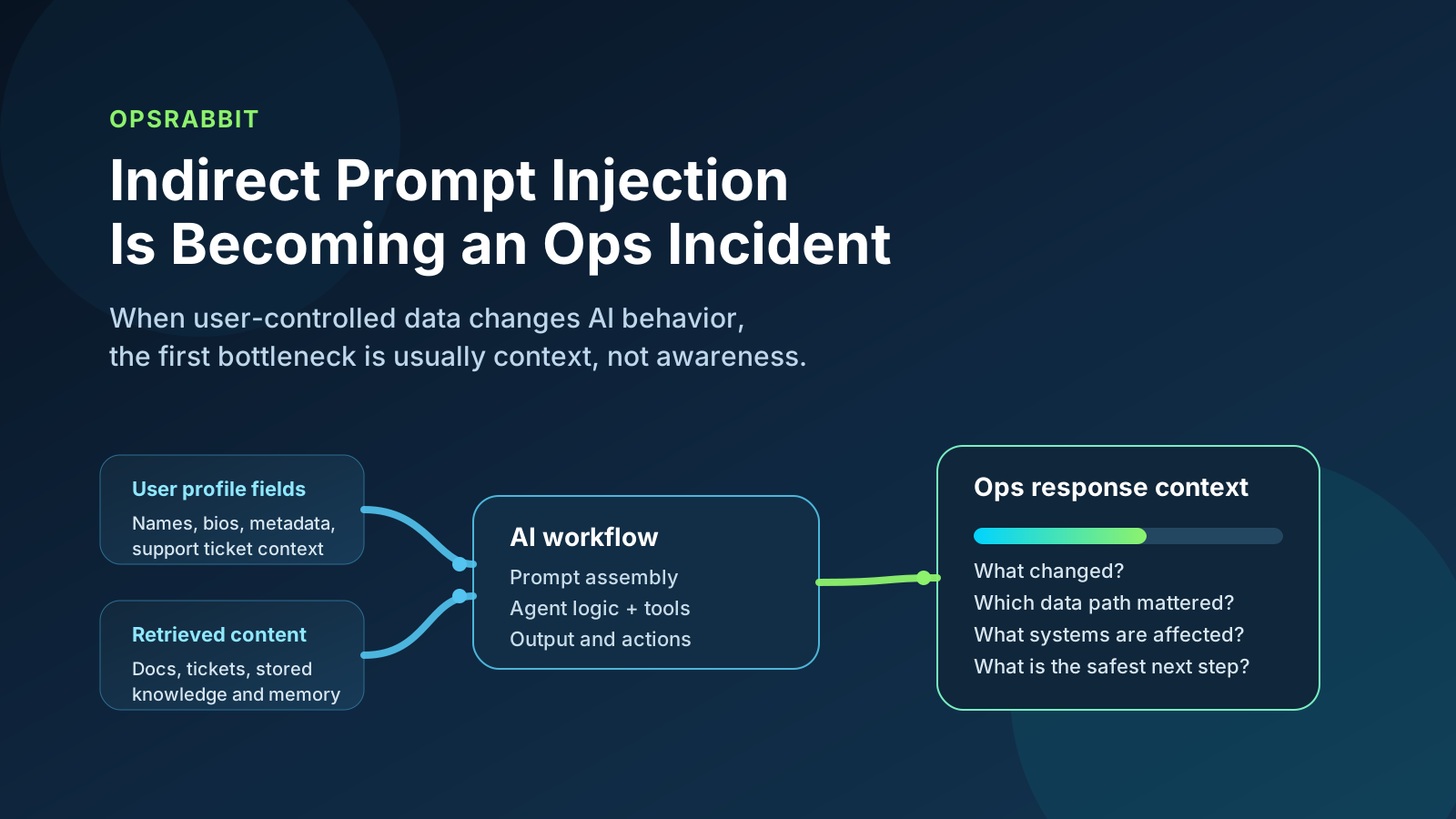
The hard part is rarely noticing that something is off. The hard part is building enough trusted context to act.
Why this is messy for operations teams
The operational pain comes from context fragmentation.
When an AI workflow goes sideways, the evidence usually lives in different places:
- application logs
- orchestration traces
- model or guardrail outputs
- retrieval layer data
- user profile metadata
- tool-call history
- recent code or prompt changes
- ownership docs
- Slack or ticket threads
Most teams technically have this information somewhere. They just do not have it in one usable story.
That means the first 30 minutes can disappear into a very familiar pattern:
- one person checks the app
- one person checks the vector store or retrieval path
- one person tries to reproduce the prompt flow
- one person asks whether a recent deploy changed the agent behavior
- one person pings the service owner
- everyone else waits for a coherent answer
This is exactly the kind of slowdown that turns a strange AI issue into a real incident.
What responders should do first
A practical first response to this kind of issue is not especially glamorous. It looks a lot like good incident response everywhere else.
1. Contain the workflow before proving the full root cause
If a tool-calling agent is taking risky actions, reduce blast radius first. That might mean disabling a workflow, restricting tool access, rolling back a recent prompt or policy change, or switching to a safer fallback path.
Microsoft's framing here is right: stop the bleed first. Investigation can run in parallel.
2. Identify the data path, not just the user prompt
Do not assume the dangerous instruction came through the obvious input. Check:
- user-editable fields
- retrieved documents
- ticket metadata
- summaries from previous turns
- external connector outputs
- tool responses being fed back into the model
Praetorian's point is the important one: if the system treats contextual data as trusted, defenders can miss the real entry point.
3. Review what changed recently
Many incidents become easier once you line up the timeline. Look for:
- recent prompt or policy edits
- model changes
- retrieval tuning changes
- connector changes
- new tools or expanded permissions
- unusual content inserted into documents or records
- spikes in user complaints or suspicious outputs
4. Triage by business impact
A weird response in a demo bot is not the same as a workflow that can approve access, message customers, or trigger infrastructure changes.
The right priority question is simple: what can this workflow do if it keeps behaving incorrectly?
5. Build one shared incident narrative
This matters more than people think. Responders need one place that explains:
- what happened
- what evidence supports it
- which data path looks suspicious
- what was contained
- what remains uncertain
- what action comes next
Without that, the team loses time in meetings and chat scrollback instead of reducing risk.
Where OpsRabbit fits
This is the gap OpsRabbit is designed to close.
OpsRabbit is not a magical shield that makes prompt injection vanish. That is not the point.
The practical value is faster time-to-context. When an AI-integrated workflow starts misbehaving, teams need a working story quickly:
- what changed
- which workflow or service is affected
- what supporting evidence exists
- who owns the systems that matter
- what next action is worth taking first
That is the difference between a noisy AI incident and a manageable one.
Why the keyword choice matters
There is a lot of generic AI security content already. I think the more useful framing for this post is not just "prompt injection" on its own. It is the moment prompt injection becomes incident response work for operations teams.
That is why the strongest search and positioning language here is:
- indirect prompt injection incident response
- AI incident response for operations teams
- prompt injection ops incident
- time-to-context AI incident response
Those phrases match the real question practitioners are starting to ask: not just "what is this attack," but "how do we investigate and contain it in a live system?"
Final thought
Indirect prompt injection is still often described like a model-behavior problem. I think that framing is too narrow.
Once AI systems can read user data, pull retrieved context, call tools, and influence production workflows, the question stops being whether prompt injection is real. The question becomes whether your response process can keep up when it shows up in a messy, half-obvious way.
The teams that handle this well will not be the ones with the fanciest AI demo. They will be the ones that can answer, quickly and credibly:
- what changed
- what data path mattered
- what is affected
- what should happen next
That is the operations gap OpsRabbit is built to close.
FAQs
Why is indirect prompt injection an operations problem?
Because once an AI workflow behaves unexpectedly, teams need to understand the affected systems, data paths, ownership, and safest containment step before they can act confidently.
What should teams do first during an AI workflow incident?
Contain the risky workflow, identify the user-controlled or retrieved data path involved, review recent changes and outputs, and build one shared incident narrative with evidence.
Sources
- Praetorian, Bypassing LLM Supervisor Agents Through Indirect Prompt Injection - accessed April 21, 2026.
- Microsoft Security, Incident response for AI: Same fire, different fuel - accessed April 21, 2026.
- Microsoft Security, The agentic SOC: Rethinking SecOps for the next decade - accessed April 21, 2026.
- Google Threat Intelligence Group, Distillation, Experimentation, and (Continued) Integration of AI for Adversarial Use - accessed April 21, 2026.
- IBM, Cost of a Data Breach 2025 - accessed April 21, 2026.
Last Updated
2026-04-21
Ready to Transform Your Operations?
Ask for a demo today. Experience how OpsRabbit can reduce your MTTR by up to 90%.