Quick answer: Kubernetes user namespaces improve runtime isolation in a very real way, but the bigger ops story is this: safer containers only help so much if your responders still rely on broad access, scattered context, and slow incident investigation.
TL;DR
- Kubernetes user namespaces are now GA in v1.36.
- They let pods run with root-like behavior inside the container without mapping that identity directly to host root.
- That is good news for runtime isolation, especially in production Kubernetes environments.
- But teams also need to update debugging and incident response workflows so safer runtime posture does not get undercut by risky access patterns.
What problem are we solving?
A lot of platform teams are looking at Kubernetes user namespaces and asking a sensible question:
What actually changes for us?
The release notes answer the feature question. They do not fully answer the operator question.
Because production reality is messy. When an incident hits, teams do not care only that a security feature exists. They care whether they can still debug safely, how access should work, and how quickly they can figure out what changed.
That is where this topic gets interesting.
Short answer
User namespaces make it harder for a container escape or misconfiguration to translate directly into host-level root impact. In Kubernetes, that means a pod can opt in with hostUsers: false and run in a user namespace where capabilities are scoped differently.
That is a real improvement.
But it does not remove the need for disciplined debugging access or fast incident context. In practice, the most resilient teams will pair user namespaces with least-privilege debugging, short-lived credentials, and a faster way to assemble investigation evidence when something breaks.
What changed in Kubernetes
Kubernetes announced user namespaces as GA in v1.36 on April 23, 2026.
At a high level, user namespaces isolate the user identity inside the container from the user identity on the host. So a process that appears to be root inside the container is mapped away from host root. That reduces the blast radius if something escapes the container boundary.
The Kubernetes docs are also pretty clear about the practical requirements:
- this is Linux-only
- the stack needs support for idmapped mounts
- the file systems involved need to support that model
- teams opt a pod in by setting
hostUsers: false
That is the technical shift.
The operational shift is what comes next.
Why this matters for production debugging
A lot of production debugging habits were built around speed first and control second.
When something is on fire, teams often fall back to:
- cluster-admin privileges that are broader than necessary
- shared bastions or jump boxes
- long-lived credentials
- ad hoc exec access that is hard to audit later
Kubernetes' recent guidance on securing production debugging pushes the opposite direction: least privilege RBAC, short-lived identity-bound credentials, and just-in-time access workflows.
That guidance matters even more now.
User namespaces improve isolation inside the runtime. But if the response workflow still relies on broad, standing access, a lot of the practical security benefit gets diluted during the most stressful moment: the live incident.
The real ops implication: safer runtime, safer response
This is the part that tends to get missed.
A runtime control becoming stronger does not automatically make incident response stronger. It changes the shape of what “safe enough” should look like.
If your environment adopts user namespaces, your response model should also mature in parallel:
- responders should know which workloads are using
hostUsers: false - access should be scoped tightly enough that debugging does not become a back door to overprivilege
- teams should be able to see recent deploys, ownership, runtime evidence, and likely next actions without manually stitching it all together
That last part is where a lot of teams still lose time.
Where incidents still slow down
Even in mature Kubernetes shops, the slowdown is often not detection. It is context assembly.
An alert fires. A pod is failing. A rollout looks suspicious. A privileged workflow behaves differently than expected.
Now the responder needs to answer:
- what changed recently
- which workloads are affected
- whether the issue is tied to a config change, image change, or access path
- who owns the service
- whether the current debugging path is safe and appropriate
Those questions sit right between security posture and operational action.
And they usually span multiple tools.
A concrete example
Imagine a production service starts failing after a rollout that also introduces a runtime-hardening change. Some pods now run with user namespaces enabled, and a responder needs to inspect behavior without taking a shortcut into broad cluster access.
This is exactly the kind of moment where the team needs more than a feature announcement. They need an investigation workflow.
They need to know:
- which services adopted the change
- what dependencies sit behind the failure
- what changed in the deployment path
- what logs, events, and runtime signals support the likely root cause
- what the next safe debugging action should be
Without that context, teams either move too slowly or reach for access patterns they were trying to leave behind.
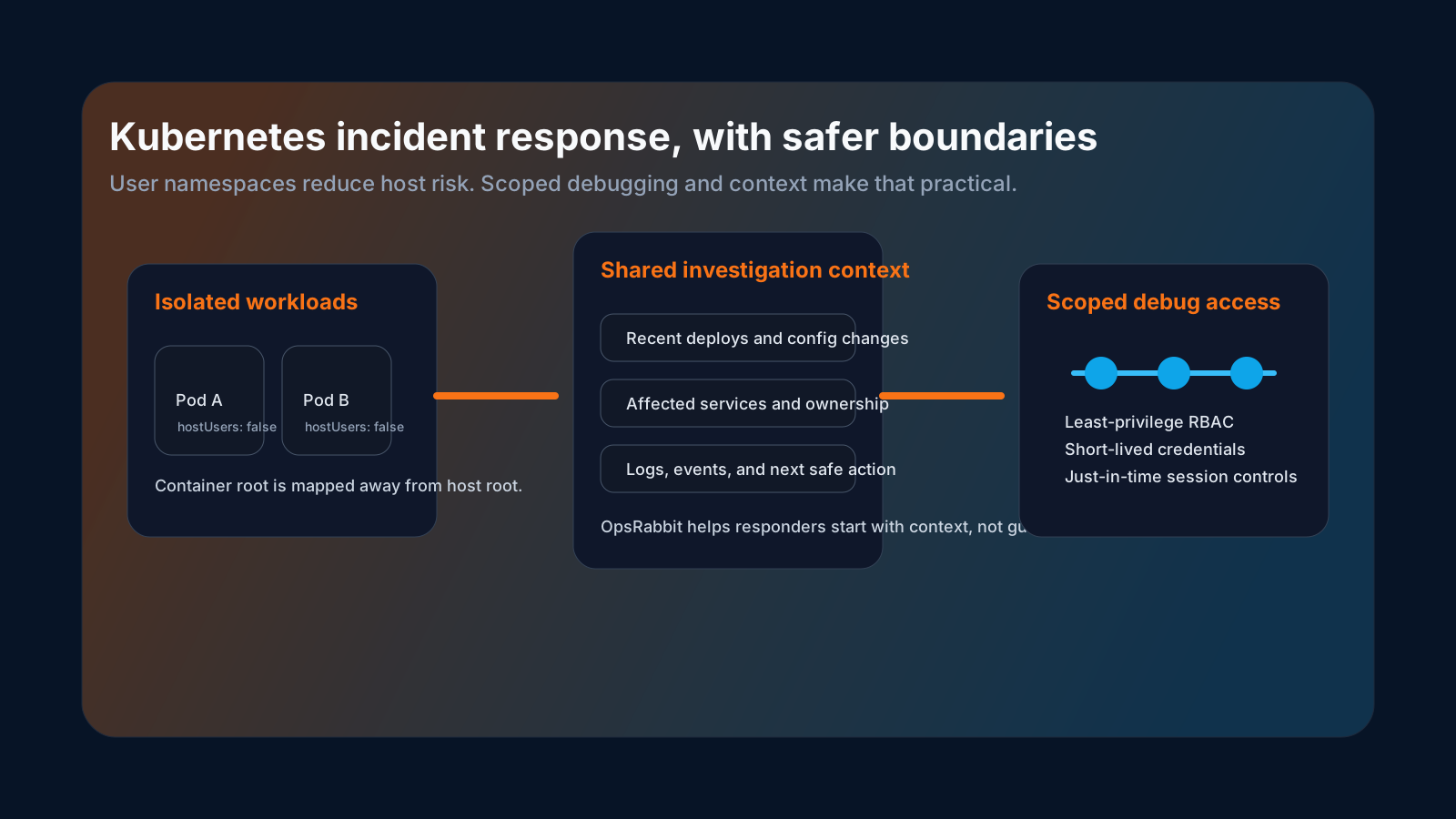
User namespaces improve isolation. The bigger operational win comes when teams pair that with faster, safer investigation workflows.
Where OpsRabbit fits
This is the gap OpsRabbit is built to help close.
OpsRabbit is not the control that enables Kubernetes user namespaces. Kubernetes already does that.
The value is in helping teams respond better once modern runtime controls are part of the environment.
That means helping responders get faster answers to questions like:
- what changed
- what is affected
- who owns it
- what evidence matters most right now
- what next action is most worth validating first
If user namespaces make production safer by default, OpsRabbit helps teams avoid giving that safety back during incident response.
Final thought
I like this Kubernetes release because it is practical. It is not vague platform futurism. It is a concrete improvement in runtime isolation.
But the real opportunity for ops teams is not just enabling a feature. It is updating the workflow around it.
Safer runtime isolation should be paired with safer debugging and faster investigation context.
That is how teams turn a good security feature into better incident response.
If your team is already juggling Kubernetes incidents, changing runtime posture, and too much manual investigation work, OpsRabbit is worth a look.
FAQs
What does hostUsers: false do in Kubernetes?
It opts a pod into user namespaces so users inside the container are mapped away from host users, improving isolation.
Do user namespaces remove the need for safer debugging workflows?
No. They improve isolation, but teams still need least-privilege access, short-lived credentials, and fast investigation context during incidents.
Sources
- Kubernetes v1.36: User Namespaces in Kubernetes are finally GA - Kubernetes Blog, April 23, 2026.
- User Namespaces - Kubernetes Documentation, accessed April 27, 2026.
- Securing Production Debugging in Kubernetes - Kubernetes Blog, March 18, 2026.
- Kubernetes v1.33: User Namespaces enabled by default! - Kubernetes Blog, April 25, 2025.
- CNCF Annual Report 2025 - CNCF, February 24, 2026.
Last Updated
2026-04-27
Ready to Transform Your Operations?
Ask for a demo today. Experience how OpsRabbit can reduce your MTTR by up to 90%.