Quick answer: AIOps is not one feature. It is a way to use AI, automation, and operational data to help teams detect issues, reduce noise, understand root cause, and act faster. OpsRabbit fits as the investigation and governed action layer that turns fragmented alerts, logs, changes, tickets, and service knowledge into evidence-backed next steps.
TL;DR
- AIOps means different things to different teams: fewer alerts, faster RCA, better service context, self-healing, DevOps acceleration, capacity awareness, security correlation, or executive reliability.
- Most teams should start with the painful middle of operations: the gap between an alert firing and a responder knowing what to do next.
- OpsRabbit is strongest where AIOps needs live context: alert triage, evidence collection, change correlation, dynamic runbooks, recommended commands, handoff summaries, and governed remediation.
- The right promise is not "AI fixes everything automatically." The useful promise is "AI gets the right evidence and action plan in front of the right team faster."
Why AIOps Is Such a Loaded Term
AIOps stands for artificial intelligence for IT operations. That sounds simple until five people enter the same meeting with five different expectations.
An SRE may hear AIOps and think, "Can it tell me why latency spiked after the last deploy?"
A NOC lead may hear AIOps and think, "Can it suppress duplicate alerts and route the real incident?"
A CIO may hear AIOps and think, "Can this reduce downtime and reduce the pressure on senior engineers?"
A platform engineer may hear AIOps and think, "Can it connect CI/CD, Kubernetes, Terraform, and service ownership before someone asks me to join another bridge?"
All of those expectations are fair. The mistake is treating AIOps as one magic feature instead of a set of operational use cases.
A Practical AIOps Model
The simplest way to understand AIOps is as an operating loop:
- Detect: An alert, event, ticket, metric, log pattern, synthetic check, or user report appears.
- Correlate: The system groups related signals and checks service, dependency, ownership, and change context.
- Diagnose: AI helps identify likely cause, blast radius, missing evidence, and confidence.
- Recommend: The responder gets commands, rollback options, escalation notes, or change steps.
- Act: The team executes manually, approves a governed automation, or hands off to the right owner.
- Learn: The investigation becomes reusable operational memory for future incidents.
OpsRabbit is built for the middle of that loop: correlation, diagnosis, evidence collection, recommended action, and handoff.
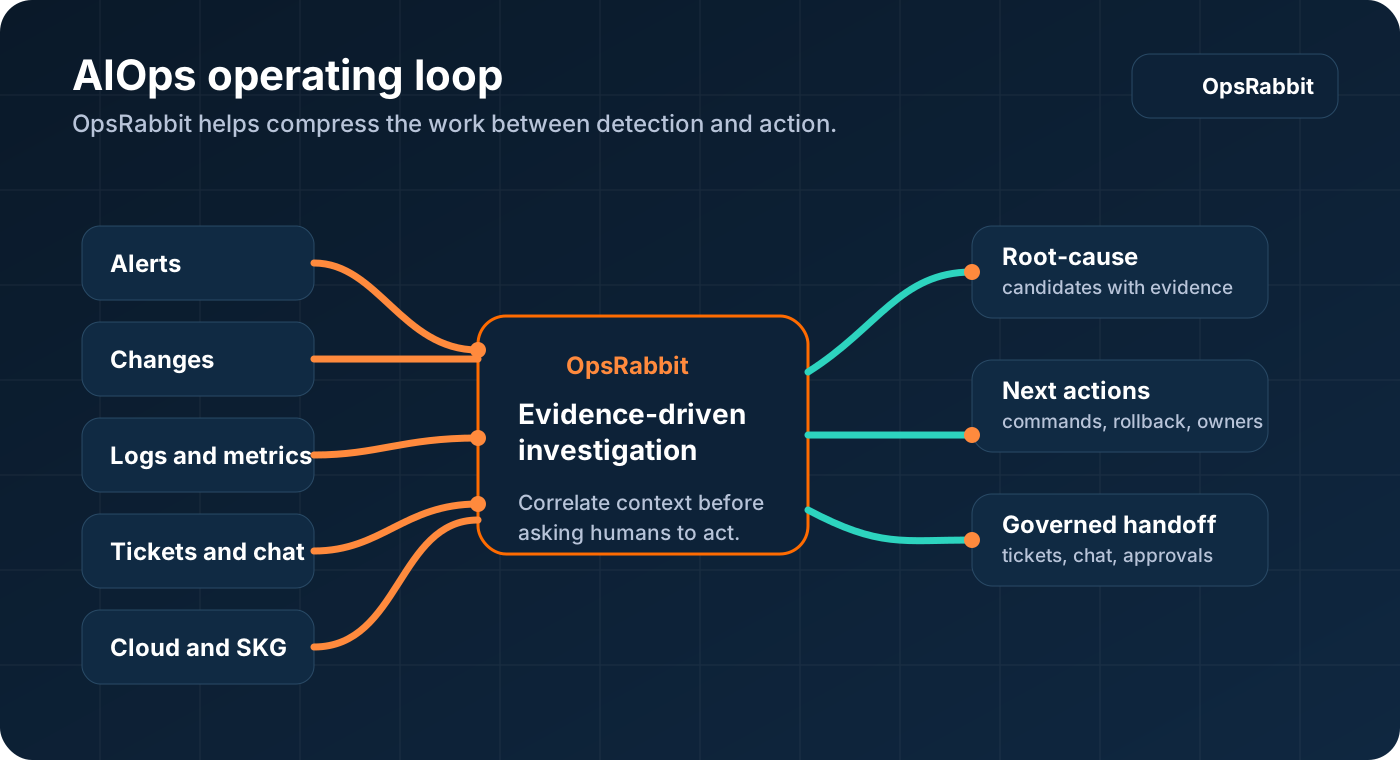
The operational win is not just more detection. It is faster movement from signal to trusted context to governed action.
1. Alert Noise Reduction and Event Correlation
For many ITOps and NOC teams, AIOps starts with alert fatigue.
The expectation: "Do not wake up five teams for the same underlying issue."
Example: A payment API has a latency spike. Datadog fires a service latency alert, CloudWatch reports load balancer target errors, Kubernetes reports pod restarts, and PagerDuty opens multiple incidents. A human sees four problems. The real issue may be one overloaded downstream dependency.
How OpsRabbit fits: OpsRabbit can receive the alert, identify the impacted service, collect related signals, check dependency context, and summarize likely blast radius. Instead of treating every alert as a separate investigation, the team gets one operating view: what is affected, what else is noisy, what changed, and who owns the next step.
This is where the language should be explicit: OpsRabbit helps with alert triage, alert context, and noise reduction through investigation context. It should not be positioned as only another alert inbox.
2. Root Cause Analysis
For SRE teams, AIOps often means faster RCA.
The expectation: "Show me the likely cause and the evidence, not just a confidence score."
Example: Error rates increase after three teams shipped within the same hour. One service was deployed, one feature flag changed, one Terraform module updated a security group, and one dependency started timing out. The incident bridge can easily spend 20 minutes arguing about ownership.
How OpsRabbit fits: OpsRabbit correlates deploys, pull requests, configuration changes, pipeline events, logs, metrics, traces, and service dependencies. The useful output is not "the AI says deploy X is bad." The useful output is an evidence-backed candidate: the suspicious change window, affected services, supporting logs, missing checks, rollback option, and escalation note.
That is the kind of RCA that responders can actually use under pressure.
3. Dynamic Runbooks and Investigation Plans
Traditional runbooks are useful when the incident behaves exactly as expected. Modern incidents rarely do.
The expectation: "Give me a runbook that adapts to this incident."
Example: A database latency alert fires. A static runbook says to check CPU, connection count, slow queries, replication lag, and disk. Those checks are fine, but the real question is which one matters right now. If a schema migration landed 12 minutes before the alert and only one service caller is affected, the runbook should adapt.
How OpsRabbit fits: OpsRabbit can build a fresh investigation plan from alert type, service ownership, dependencies, recent changes, operational history, and available tools. It can gather query behavior, application errors, saturation trends, schema changes, and caller context before recommending the next step.
That turns a stale checklist into an evidence-first workflow.
4. Automated Remediation and Self-Healing
This is the flashiest AIOps promise and the easiest one to overstate.
The expectation: "Can AI fix production automatically?"
The better question: "Which actions are safe to automate, which need approval, and which need a human decision?"
Example: A pod is crash-looping because a bad config was deployed. A naive self-healing loop might restart pods forever. A useful AIOps workflow checks the recent config change, compares the failure signature, identifies the rollback path, and asks for approval before changing state.
How OpsRabbit fits: OpsRabbit is best positioned as governed action, not blind autonomy. It can recommend commands, rollback options, pull request paths, and remediation steps. Sensitive actions can stay behind approval gates, read-only investigation can happen first, and the output can include an evidence log.
That is more credible for enterprise teams than promising fully autonomous production repair on day one.
5. Service Topology, Ownership, and Blast Radius
AIOps is not just about machine learning. It is also about context.
The expectation: "Tell me what this service depends on, who owns it, and whether customers are affected."
Example: A healthy-looking frontend service starts timing out for a subset of customers. The service itself has normal CPU and memory. The failure is a downstream auth dependency in one region. Without topology, the first alerted team wastes time proving its own service is healthy.
How OpsRabbit fits: OpsRabbit's service knowledge graph can map services, owners, dependencies, infrastructure, deployments, and operational history into one investigation context. During incidents, that context helps teams understand blast radius and route the problem to the right owner faster.
This is one of the most important AIOps expectations because many incidents are coordination failures before they are technical failures.
6. Change Intelligence for DevOps and Platform Teams
DevOps teams often do not describe their pain as AIOps. They say, "Something broke after a release and nobody knows which change caused it."
The expectation: "Connect operational symptoms to recent change."
Example: A customer-facing API starts returning intermittent 500s. In the same window, a new container image was deployed, a pipeline skipped one test stage, a feature flag changed, and Terraform updated a network policy.
How OpsRabbit fits: OpsRabbit can inspect CI/CD metadata, recent commits, pull requests, config changes, deployment events, and infrastructure changes. It can produce a short list of suspicious changes with supporting evidence and recommended next steps: rollback, compare config, test dependency path, or escalate to the owning team.
This is AIOps for the software delivery era.
7. Cloud and Kubernetes Operations
Cloud-native systems generate huge volumes of operational data. The hard part is not finding data. The hard part is knowing what matters.
The expectation: "Connect cluster events, cloud metrics, IaC, workload health, and ownership."
Example: A Kubernetes workload is restarting. The visible symptom is OOMKilled, but the actual cause may be a recent memory limit change, a traffic shift, a node pressure event, or a dependency retry storm.
How OpsRabbit fits: OpsRabbit can gather cluster events, pod status, workload configuration, recent Terraform or Helm changes, cloud metrics, and service dependencies. The goal is to separate symptom from cause: workload sizing, node pressure, deployment regression, dependency behavior, or cloud throttling.
That helps platform teams avoid the usual "check Kubernetes, then check cloud, then check Git, then ask in chat" loop.
8. SecOps and Security-Relevant Operations Incidents
Some security events are also operations incidents. Token exposure, package compromise, prompt-driven automation, and suspicious runtime behavior all create service impact questions.
The expectation: "Help security and operations share the same evidence trail."
Example: A suspicious package version is discovered in a dependency tree. Security wants containment. Operations needs to know which services use it, where it is deployed, whether runtime behavior changed, who owns the services, and what rollback path is available.
How OpsRabbit fits: OpsRabbit can link security signals with service behavior, recent code or package changes, cloud audit events, runtime logs, and containment options. The output should help both teams answer: what is exposed, what is affected, what changed, what should be isolated, and who can approve the action.
This is a strong AIOps story because AI-era risk increasingly crosses the boundary between SecOps and ITOps.
9. ITSM, Collaboration, and Handoff Automation
AIOps does not help much if the answer stays trapped in a dashboard.
The expectation: "Put the investigation where the team already works."
Example: A PagerDuty incident opens, a Jira ticket already exists for a related deploy, Slack has the service owner conversation, and ServiceNow needs the final incident record. The responder should not manually rewrite the same summary four times.
How OpsRabbit fits: OpsRabbit can integrate with incident management, collaboration, and ticketing tools so investigation summaries, evidence, owner notes, customer-impact language, and next steps can follow the operating workflow.
This is where AIOps becomes operationally useful: not just insight, but a clean handoff.
10. Executive Reliability and Operational Memory
Executives do not buy AIOps because they love event correlation. They care about downtime, risk, productivity, and repeatability.
The expectation: "Make operations more resilient and less dependent on a few senior people."
Example: Every major incident waits for the one engineer who remembers the payment service dependency map. That engineer knows which dashboard matters, which Terraform module is risky, which DBA to call, and which rollback is safe. The organization does not have an incident response problem only. It has a knowledge bottleneck.
How OpsRabbit fits: OpsRabbit captures service ownership, dependency patterns, recurring incident fingerprints, evidence trails, and operational summaries. Over time, the organization gets less dependent on tribal knowledge and more consistent in how incidents are investigated, escalated, and reviewed.
That is the executive version of AIOps: faster decisions, lower operational drag, and better institutional memory.
Where OpsRabbit Should Be Precise
The strongest OpsRabbit positioning is:
OpsRabbit is an AIOps investigation and governed action platform for teams that need trustworthy incident context in minutes.
That positioning meets the broad AIOps expectation without overclaiming.
OpsRabbit should lean into:
- AI incident triage
- alert context and noise reduction
- event and change correlation
- root cause candidates with evidence
- dynamic runbooks
- service knowledge graph
- recommended commands and rollback paths
- ITSM and collaboration handoff
- approval-aware automation
- on-prem, read-only, and enterprise control patterns
OpsRabbit should be more careful with:
- full self-healing claims
- broad capacity planning claims unless the deployment includes the required data
- predictive failure claims unless there is enough historical signal
- security automation claims that imply replacing SecOps workflows
That nuance builds trust. Buyers have heard enough "AI will fix everything" promises. They respond better to a product that knows where it creates value first.
The Best First AIOps Use Cases for OpsRabbit
If a team is evaluating OpsRabbit as part of an AIOps initiative, start with these:
High-severity incident triage
Use OpsRabbit to gather alert context, service ownership, dependencies, recent changes, logs, metrics, and escalation notes before the bridge gets crowded.
Deployment regression investigation
Use OpsRabbit to correlate symptoms with deploys, pull requests, pipeline events, config changes, and infrastructure updates.
Cloud and Kubernetes incident investigation
Use OpsRabbit to pull together cluster events, workload health, cloud metrics, IaC changes, and ownership context.
Database latency and saturation
Use OpsRabbit to connect slow queries, caller services, schema changes, connection behavior, saturation signals, and application errors.
Runbook and automation generation
Use OpsRabbit to convert recurring investigation patterns into dynamic runbooks, diagnostic steps, approval checkpoints, and reusable workflows.
Security-relevant operations incidents
Use OpsRabbit to link suspicious runtime behavior, tokens, packages, cloud audit events, code changes, and containment paths.
Short Answer
AIOps is best understood as a practical operating model, not a product label. Different teams expect different outcomes: fewer noisy alerts, faster RCA, better service context, safer remediation, better handoffs, and less operational toil.
OpsRabbit caters to those expectations by sitting between detection and action. It gathers evidence, correlates service and change context, creates dynamic investigation plans, recommends next steps, and keeps risky actions governed.
FAQs
What does AIOps mean?
AIOps means applying AI, machine learning, automation, and operational data to improve IT operations, especially detection, triage, root cause analysis, and response.
Where does OpsRabbit fit in AIOps?
OpsRabbit fits between the alert and the action. It gathers evidence, correlates operational context, recommends next steps, and supports governed remediation workflows.
Is OpsRabbit a self-healing platform?
OpsRabbit supports governed action and automation, but the strongest first value is faster investigation, evidence-backed recommendations, and approval-aware execution.
Sources
- What is AIOps? - IBM.
- What is AIOps? - Amazon Web Services.
- What is AIOps? - Atlassian.
- AI for IT Operations on Cloud Platforms: Reviews, Opportunities and Challenges - arXiv, 2023.
- Artificial Intelligence for IT Operations Workshop White Paper - arXiv, 2021.
Last Updated
2026-06-18
Ready to Transform Your Operations?
Ask for a demo today. Experience how OpsRabbit can reduce your MTTR by up to 90%.