Quick answer: AI can help teams start investigations faster, but long incidents still break down when critical context gets scattered across too many tools and too many turns. That is turning model memory limits into a real operations problem.
TL;DR
- AI investigation tools are getting better at triage, but not every incident fits neatly into one prompt or one screen.
- Responders still lose time when evidence is fragmented across alerts, logs, deploy history, ownership data, and chat.
- The practical issue is not just model intelligence. It is whether the workflow preserves enough trusted context for the next safe action.
- OpsRabbit fits in the gap by helping teams assemble incident context into a usable operating story.
What problem are we solving?
There is a tempting story in the market right now.
You add AI to incident response, the system summarizes everything, and responders stop wasting time jumping between tools.
That story is directionally right, but it skips the part where real incidents are messy.
A live investigation rarely arrives as one clean bundle of evidence. It unfolds in pieces:
- an alert from one tool
- a suspicious deploy from another
- ownership details buried somewhere else
- chat discussion that changes the team's understanding halfway through
- extra telemetry that only matters after the first hypothesis fails
That is where a lot of AI-assisted workflows still wobble.
The model may be smart. The workflow may still be brittle.
Short answer
The context window problem in incident response is not just about token limits or model specs.
Operationally, it means the investigation system stops holding onto the right evidence, decisions, and state as the incident evolves.
When that happens, responders do one of three things:
- re-prompt with the same context again
- manually reconstruct the incident story in Slack or tickets
- fall back to old-school tab hopping and log hunting
That is not a minor UX flaw. It directly slows response.
Why this matters now
This problem is getting more important for two reasons.
First, the market is moving quickly toward agentic workflows.
Microsoft's recent framing of the agentic SOC is useful because it treats AI as part of the operating model, not just a chatbot on top of security tools. If AI agents are expected to assemble evidence and help guide investigations, then keeping context coherent becomes part of the job.
Second, the environments being investigated are getting more complex.
Microsoft's April 2026 guidance on incident response for AI makes the point that the fundamentals of response do not change, but the speed, telemetry, and validation burden do. IBM's Cost of a Data Breach 2025 report also ties lower breach costs to faster identification and containment, while showing serious AI oversight gaps across organizations.
In plain language: teams are being asked to move faster inside noisier systems.
That is exactly when context falls apart.
What a context-window failure looks like in the real world
This does not have to mean a model literally forgets everything.
Sometimes the failure is subtler.
The assistant remembers the alert but loses the relevance of the last deploy. It summarizes the logs but drops the service owner. It explains the current symptom but forgets the earlier branch of investigation that was already ruled out. It gives a plausible next step without carrying forward the constraints the team already uncovered.
The result is familiar:
- duplicate investigation work
- shaky recommendations
- slower handoffs between responders
- growing distrust in the AI layer
And the longer the incident runs, the worse this gets.
Fragmented evidence is the real enemy
I think this is the more useful way to frame the problem.
The blocker is usually not that the model is too dumb. The blocker is that incident evidence is fragmented by default.
A responder may need to combine:
- detection alerts
- logs, traces, and metrics
- deploy and config history
- identity events
- service ownership
- prior incident notes
- ticket or change context
- discussion happening live in chat
If those pieces do not get assembled into one trusted working picture, the model has to keep rediscovering the same story.
That is expensive in both time and confidence.
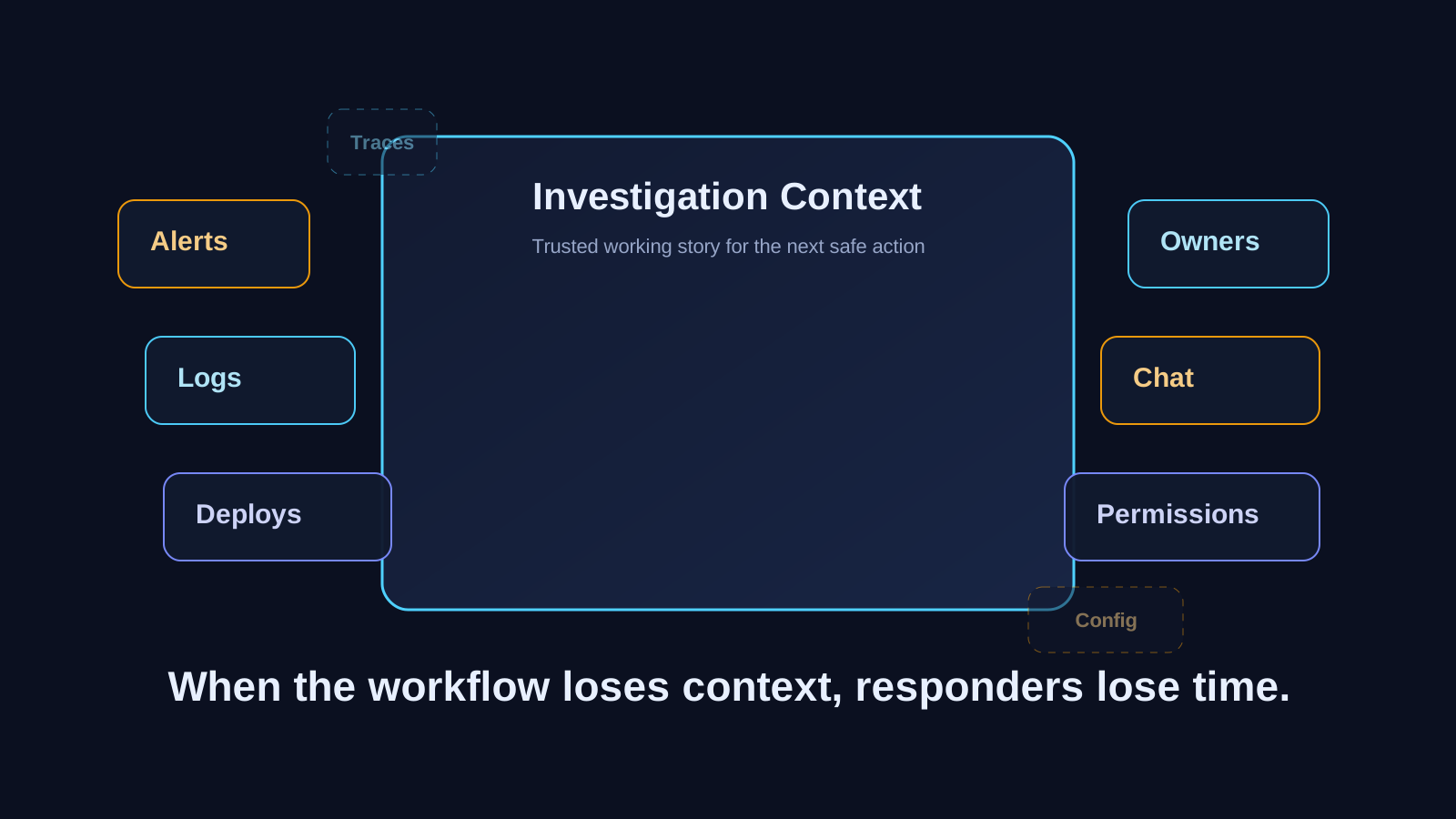
The issue is not just how much a model can read. It is whether the investigation workflow keeps the right context alive as the incident evolves.
Why AI-connected systems make this worse
The rise of AI-connected tooling adds another layer.
Praetorian's MCP server research is a good reminder that integration layers can become meaningful attack and operations surfaces of their own. Once assistants and agents can touch external systems, the investigation has to account for tool behavior, permissions, connected data, and possible workflow manipulation too.
So now responders are not just asking "what changed in production?" They are also asking "what did the AI-connected path touch, infer, or trigger?"
That adds more state to preserve. Not less.
What a better incident workflow should preserve
A good AI-assisted investigation workflow should keep the things responders actually need to act:
- the current hypothesis
- what evidence supports it
- what evidence weakened earlier theories
- what changed recently
- which systems and owners are in scope
- what next actions are safest to validate first
This is less about conversational elegance and more about operational continuity.
The best investigation systems help the team avoid rehydrating the case from scratch every time the incident takes a new turn.
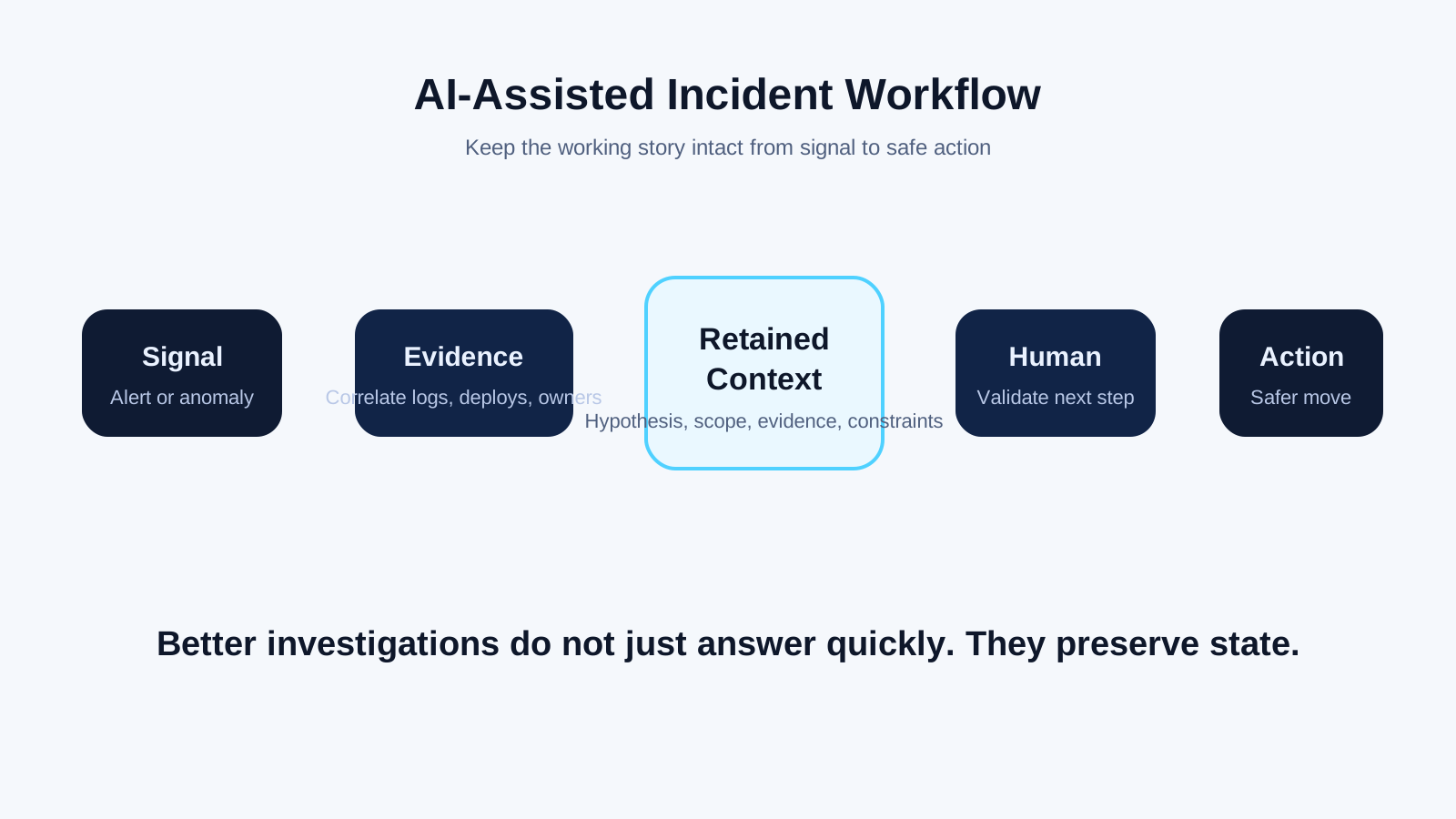
Better AI-assisted investigations keep the working story intact while responders validate the next move.
Where OpsRabbit fits
This is the gap OpsRabbit is built to make smaller.
OpsRabbit is not just trying to summarize alerts faster. The more practical value is helping teams assemble operational context into a usable incident story inside the workflow they already use.
That means pulling together the evidence responders care about most:
- what changed
- what services are affected
- who owns the path
- what signals correlate
- what likely next actions deserve attention first
When that story stays coherent, teams spend less time re-pasting context and less time repeating work.
Final thought
AI in incident response is real. I do not think the problem is hype alone.
But the next bottleneck is becoming clearer.
It is not enough for an AI tool to sound smart in the first five minutes of an incident. It has to stay useful in minute 25, when the evidence is messy, the room is tired, and the team needs the next safe move.
That is why context windows are becoming an ops problem.
The winning workflow is not just the one that answers quickly. It is the one that keeps enough trusted context alive to help humans act with confidence.
FAQs
What is an AI investigation context window problem?
It is the point where an AI-assisted investigation stops carrying forward enough trusted evidence, decisions, and incident state to support the next safe action.
Why does this matter for incident response?
Because long incidents are messy. When responders have to keep rebuilding the story manually, triage may be fast but resolution still slows down.
Sources
- Microsoft Security, Incident response for AI: Same fire, different fuel - accessed April 30, 2026.
- Microsoft Security, The agentic SOC—Rethinking SecOps for the next decade - accessed April 30, 2026.
- IBM, Cost of a Data Breach Report 2025 - accessed April 30, 2026.
- Praetorian, MCP Server Security: The Hidden AI Attack Surface - accessed April 30, 2026.
Last Updated
2026-04-30
Ready to Transform Your Operations?
Ask for a demo today. Experience how OpsRabbit can reduce your MTTR by up to 90%.