Quick answer:
AI in SREstops being a demo the moment an agent can investigate alerts, touch infrastructure, or influence incident flow. At that point, the real question is not whether the agent is clever. It is whether it has a real identity, enough live context, and a safe way to hand work back to humans.
TL;DR
- Google is now describing SRE AI as a production operations layer, not just a chat assistant.
- That is a strong signal for every team evaluating proactive operations agents.
- The practical requirements are pretty simple: strong identity, live context, and fallback paths.
- If any one of those is weak, the incident room still slows down.
What changed
For a while, most AI-in-ops conversations were really about assistants.
Ask a question. Get a summary. Maybe generate a query or a playbook draft.
That is useful, but it is still a sidecar.
The new shift is more operational. In late June, Google described how its SRE teams are using agentic AI to improve operations across alerting, incident communications, investigation, playbook quality, and postmortem work. Earlier this year, Google Cloud also repositioned Gemini Cloud Assist as a proactive cloud operations platform that can cluster alerts, explore parallel hypotheses, and hand complete context to support.
That is not "AI might help ops someday."
That is a big operator saying the control plane is changing now.
Why this matters for the rest of us
The interesting part of Google's write-up is not just that it has more agents.
It is that Google is unusually explicit about what those agents need before they can be trusted:
- strong identity and assigned roles
- transparency into why they took an action
- clear backup options
- continuous evaluation
- access to the right production data
That list is more useful than a hundred vague AI platform demos.
It tells you where the real operational bottlenecks are.
And DORA lands on a similar point from a different angle. Its AI capabilities model says AI is an amplifier, not an automatic upgrade. Teams get better results when they already have healthy internal data, strong version control, smaller change batches, and quality internal platforms.
Put those together and the message is pretty blunt:
AI in SRE works best when the surrounding operational system is already built to support good decisions.
Requirement 1: strong identity and scoped action
This is the first thing I would check in any SRE agent rollout.
What identity does the agent actually have? What systems can it read? What systems can it change? Which actions require human approval?
If the answer is "it can sort of access a bunch of tools through a shared integration," that is not mature enough.
The moment an operations agent can touch kubectl, Terraform, cloud APIs, incident tooling, or chat-driven workflows, permissions become part of the incident story.
That means responders need to know:
- which identity ran the workflow
- what scope it had at the time
- what tools it called
- what write-capable paths were available
Without that, an investigation becomes guesswork fast.
Requirement 2: live context and usable handoffs
This is the part most teams underestimate.
Even a very capable agent is still operating inside an environment full of partial information:
- recent deploys
- ownership changes
- noisy alerts
- half-finished tickets
- unclear blast radius
- ongoing human decisions in chat
Google's own examples lean hard on context assembly. Its SRE agents enrich alerts, monitor communication surfaces during incidents, help with handoffs between responders, and draft postmortems from operational evidence. Gemini Cloud Assist also highlights context handoff as a core value, especially when support escalation is needed.
That is the giveaway.
The winning architecture is not "agent does everything."
It is "agent makes the next human decision easier by packaging the right context at the right time."
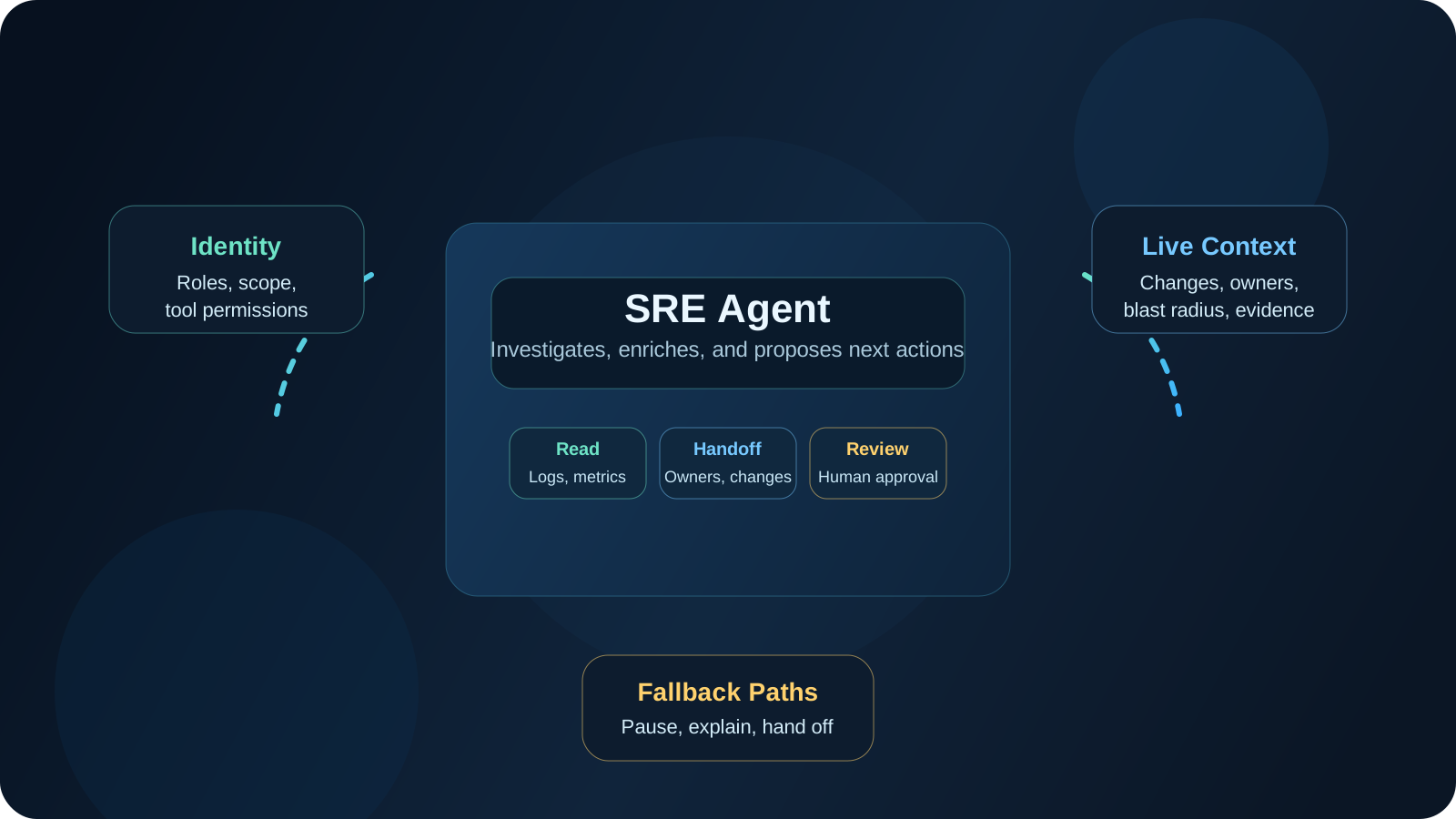
Production-grade SRE agents need more than tools. They need identity, context, and fallback controls around the tools.
If the handoff is weak, the incident room still has to reconstruct:
- what changed
- what systems are in scope
- who owns them
- what evidence matters most
- what next action is safe
That is still a time-to-context problem.
Requirement 3: fallback paths and explainability
The more proactive an operations agent becomes, the more important the backup plan becomes.
I do not mean a vague "human in the loop" checkbox.
I mean practical fallback:
- can a human review before mutation
- can the workflow pause cleanly on ambiguity
- can the agent explain what it considered and rejected
- can the team recover quickly if the agent made the wrong call
Google is explicit here too. Its principles call for backup options, explainability, reliability expectations, and business continuity planning for AI failures.
That matters because production operations are full of moments where "probably right" is not good enough.
A smart investigation summary is useful. A confident wrong remediation is expensive.
This is where a lot of teams will discover that prompt quality was never the real issue. The issue was whether the system had a safe stopping point.
What operators should implement first
If you are evaluating AI in SRE right now, I would keep the checklist brutally practical.
1. Give every agent a real operational identity
Treat the agent like a privileged operator, not like a magic feature.
2. Separate read, recommend, and mutate permissions
Do not blur troubleshooting access with write access.
3. Instrument the handoff path
Make sure the agent can surface recent changes, ownership, evidence, and proposed next steps in one place.
4. Define explicit pause and override rules
If confidence is low or scope is unclear, the workflow should stop cleanly.
5. Keep the surrounding platform boring and disciplined
DORA's point is worth repeating: good internal data, version control hygiene, and quality platforms make AI safer and more useful.
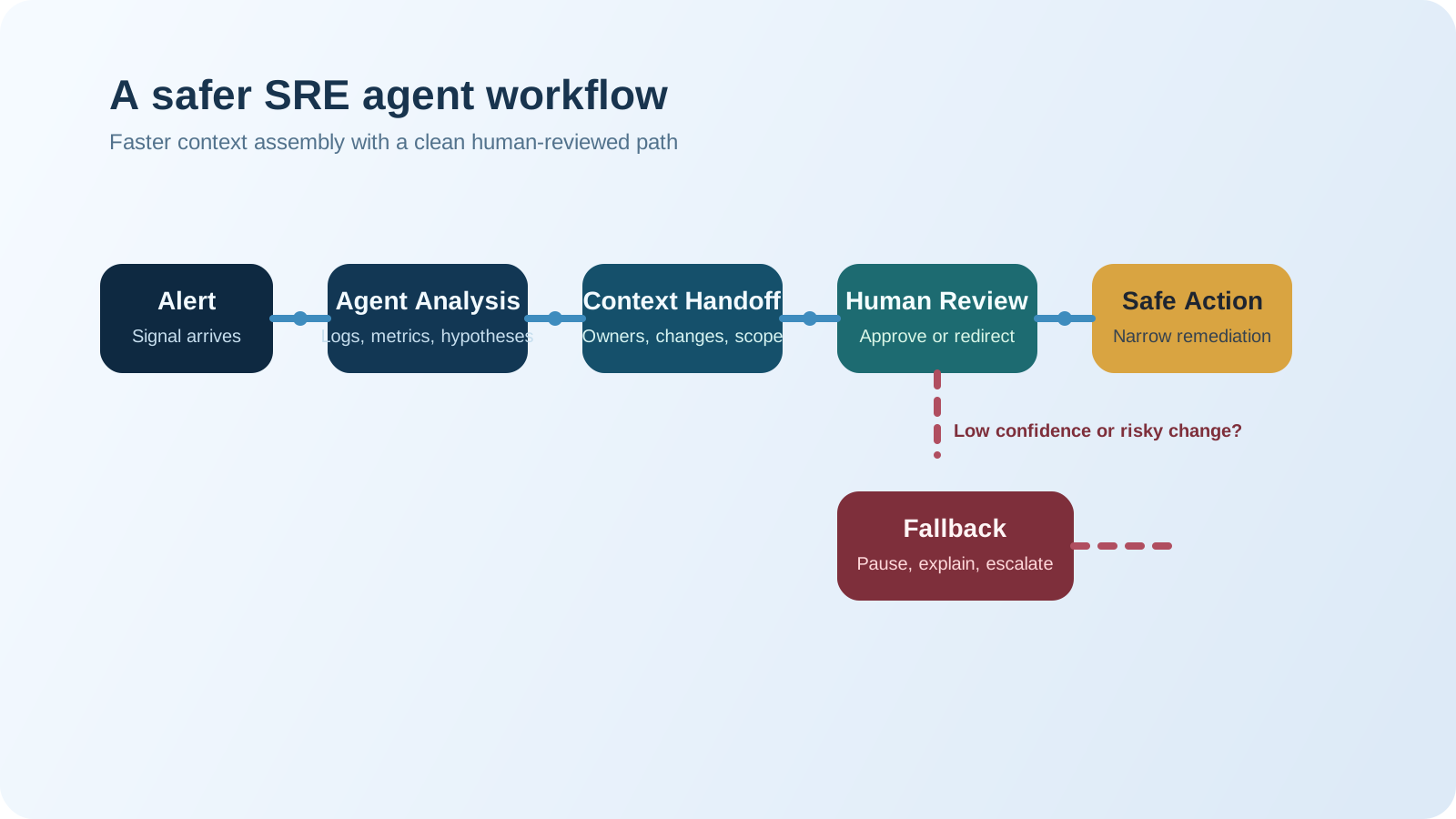
The useful pattern is not blind autonomy. It is faster context assembly with a clear human-reviewed path for action.
Where OpsRabbit fits
OpsRabbit is useful in the layer between "we got a signal" and "we are confident enough to act."
That is the layer where agents and humans both need better context:
- what changed
- which services are involved
- who owns them
- what evidence supports the likely path
- what next action is narrow enough to be safe
If proactive operations agents are going to spread, incident handoffs become more important, not less.
That is exactly where OpsRabbit helps: shortening the drag between detection, context assembly, and the next safe human decision.
Final thought
I think the market is finally asking a better question about AI in SRE.
Not "can the agent troubleshoot?"
That part is getting easier.
The better question is:
Can the team trust the agent when the environment is noisy, the incident is moving, and the next action might change production state?
That trust does not come from better prompts alone.
It comes from identity, context, and fallback paths.
FAQs
What does AI in SRE need before it can be trusted in production?
It needs a real operational identity, access to the right live context, and a safe fallback path so humans can review or override risky actions.
Why is fallback design important for SRE agents?
Because proactive operations agents can influence production state, and teams need a clean pause, explanation, or handoff path when the model is wrong or the environment is ambiguous.
Sources
- Google Cloud, How Google SRE is using agentic AI to improve operations - published June 27, 2026.
- Google Cloud, Gemini Cloud Assist at Next '26 - published April 21, 2026.
- Google Cloud DORA, From adoption to impact: Putting the DORA AI Capabilities Model to work - published December 9, 2025.
- CISA, Careful Adoption of Agentic AI Services - published May 1, 2026.
Last Updated
2026-07-02
Ready to Transform Your Operations?
Ask for a demo today. Experience how OpsRabbit can reduce your MTTR by up to 90%.