Quick answer: once an AI app can search internal systems, invoke tools, or act through MCP-connected services, it stops being just another productivity feature. It becomes part of the incident surface, because failures now involve identities, scopes, tool paths, and production consequences.
TL;DR
- Action-capable AI apps are not just a governance concern anymore. They are part of the live response surface.
- Recent vendor guidance now treats identity, action scope, dynamic tools, and app visibility as first-class security controls.
- The first slowdown in an incident is often not detection. It is figuring out which app, tool, identity, and system path are actually involved.
- OpsRabbit helps reduce that time-to-context so responders can move faster with better evidence.
What changed
For a while, a lot of enterprise AI governance sounded like policy cleanup.
Who enabled the assistant. Which team owns the pilot. Whether legal reviewed the vendor. Whether people were pasting sensitive data into chat.
That is still real, but the operating environment changed.
AI apps can now do more than answer questions. They can search internal drives, pull records from connected systems, call tools, trigger actions, and in some environments connect through MCP servers to production-adjacent resources.
That changes the response model.
If one of these systems starts behaving badly, the team is no longer dealing with a vague "AI usage" issue. They are dealing with an operational path that may involve user roles, delegated access, service identities, changing tool inventories, and data movement across third-party systems.
Why this is now an ops problem
The most useful signal here is that vendors are starting to describe the risk in operational terms.
OpenAI's current admin guidance for ChatGPT apps says admins can assign role access, review app actions before enablement, and manage action controls after publish. It also warns that custom apps and connectors are not verified by OpenAI and should only be added when the underlying application is trusted.
That matters because it is a direct acknowledgement that "app installed" is not the real unit of risk. Action scope is.
Microsoft is describing the same shift from another angle. In its May 1, 2026 Agent 365 announcement, it says agents are already spreading across apps, endpoints, and cloud services, and that unmanaged local and cloud-hosted agents are creating a new wave of shadow AI. More importantly, Microsoft says Defender context mapping for agents will show the devices they run on, the MCP servers configured for them, the identities tied to them, and the cloud resources those identities can reach starting in June 2026.
You only build that kind of visibility when the problem has become operationally real.
Google Cloud's MCP guidance is even more explicit. It says MCP-connected applications can take actions on behalf of a user and make changes that might not be reversible. It also warns that agent-only operation is vulnerable to prompt injection, insecure tool chaining, and naive error handling.
That is not future-looking theory. That is incident language.
Short answer
AI apps with actions become an incident-response problem the moment your team has to answer these questions under pressure:
- Which app or agent actually did this?
- Was it acting with a user identity, a service identity, or a shared integration?
- What tools could it call at the time?
- Did a new tool, scope, or connector get added recently?
- Which systems or data paths were reachable from that app?
- What is the safest next action right now?
That is why this belongs in operations, not just policy review.
What the first 20 minutes usually look like
When one of these systems misbehaves, responders rarely start with a neat incident package.
They start with fragments:
- a surprising action in a connected system
- unusual data access
- a user complaint that an assistant did something it should not do
- a connector that suddenly cannot authenticate
- an app that behaves differently after a scope or action update
- a workflow agent taking the wrong next step
Then the response slows down in familiar ways.
One person checks the vendor admin panel. One person checks identity logs. One person asks whether the app was using read-only actions or write actions. Someone else tries to figure out whether the issue was caused by a recent connector change, a new tool, an updated scope, or prompt-layer manipulation. Another person is still trying to find the actual owner.
That is the hidden cost.
The hard part is often not realizing something is wrong. The hard part is building enough trusted context to know what happened and what to do next.
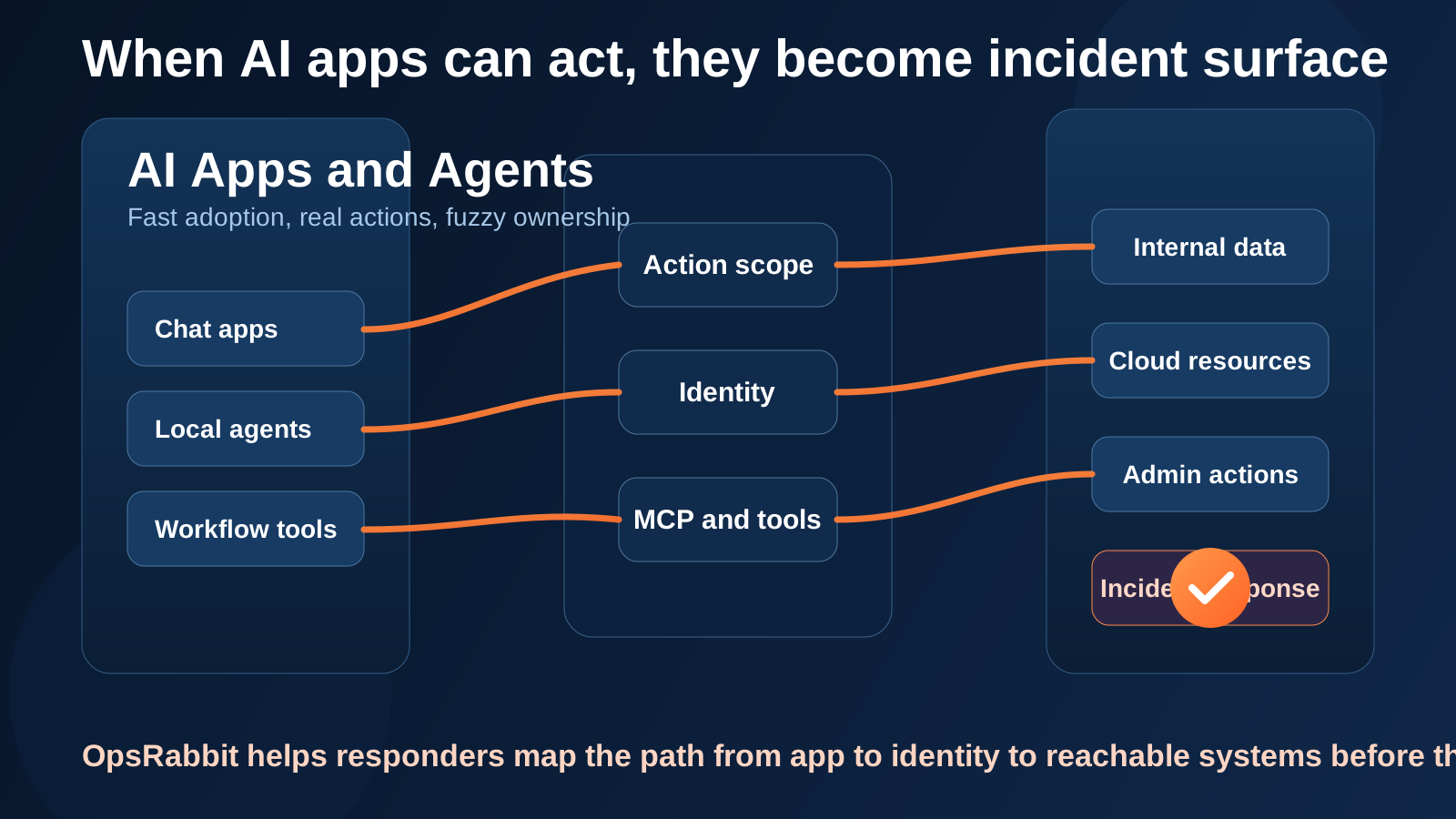
If the team cannot map the action path fast, the incident feels bigger and lasts longer.
Five guardrails that matter before the incident
1. Separate identity from convenience
Google's MCP authentication guidance is blunt: if your AI application uses your own credentials, the actions it takes are attributed to you and it gets your permissions.
That is fine for testing. It is a bad default for production.
If an app or agent can touch real systems, it needs its own scoped identity or another deliberately bounded auth pattern. Otherwise response gets messy fast because attribution and blast radius are both harder to trust.
2. Review actions, not just app names
An AI app labeled "Drive" or "CRM" does not tell you enough.
The real question is what actions are enabled, which roles can use them, and whether the system can silently gain new capabilities. OpenAI's app guidance now emphasizes action controls for exactly this reason. Google says dynamic tools can add capabilities without your approval if you are not reviewing what the agent can access.
The name of the app is not the control plane. The action set is.
3. Inventory the path from app to identity to resource
Microsoft's June 2026 context-mapping direction is useful because it reflects how responders actually think.
Not "Do we have AI?" but:
- where is this agent running
- which MCP servers or connectors does it use
- which identity is attached
- what cloud resources can that identity reach
That path is the incident surface. If you cannot map it quickly, your investigation will drag.
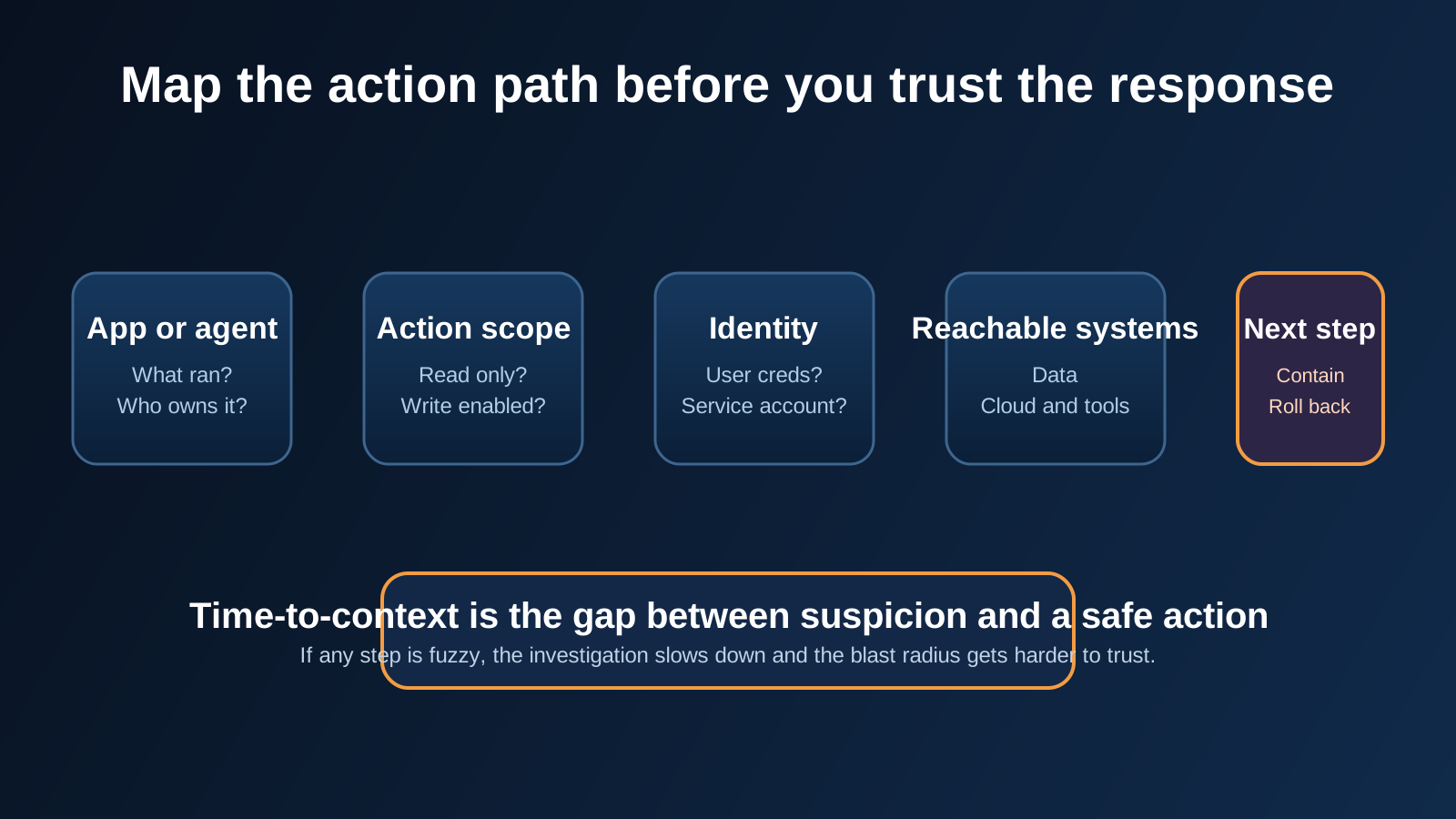
The point is not just inventory. It is faster evidence-backed decisions under pressure.
4. Treat new tools and scopes like production changes
OpenAI notes that some app updates can require scope re-authorization. Google warns that trusted MCP servers can silently add new tools.
That means AI app changes should not live in a separate mental bucket from infrastructure changes. New scopes, new actions, and new tools can all widen blast radius.
If your team would review a firewall change, admin role grant, or CI credential update, it should review these too.
5. Plan the rollback before you need it
Some AI-connected actions are reversible. Some are not.
Google's documentation explicitly reminds teams to prepare for worst-case scenarios and create recovery strategies for the data and services these agents can touch.
That is practical advice. If a tool can write, approve, publish, update, or delete, your team needs to know:
- how to disable it quickly
- how to reduce permissions
- how to reconstruct what it touched
- how to recover if the action was wrong
Time-to-context is still the real bottleneck
This is the same operational pattern OpsRabbit keeps running into across AI incidents.
Faster alerts do not solve the problem if responders still spend the next fifteen minutes assembling the story by hand.
For AI apps with actions, time-to-context includes:
- confirming the app or agent involved
- identifying the identity in use
- checking reachable systems and data
- comparing recent scope, tool, and action changes
- verifying evidence before containment or rollback
That is the work between suspicion and a safe next move.
Where OpsRabbit fits
OpsRabbit helps teams build that usable incident picture faster.
Instead of forcing responders to hop between app settings, identity systems, connector configs, cloud inventory, and chat history, it helps answer the questions that drive action:
- what changed
- what systems and identities are in scope
- what evidence matters most
- who owns the next decision
- what action is safest to validate first
That is a more useful promise than generic AI governance language.
Final thought
I do not think the biggest risk with enterprise AI apps is that teams forgot to write a policy.
The bigger risk is that these systems are getting action paths into real environments faster than incident workflows are adapting to them.
Once an app can read, call, change, approve, or trigger, it belongs in your operational map.
The teams that handle this well will not just know which AI apps exist. They will know which actions are enabled, which identities are attached, what those identities can reach, and how to build context fast when something goes sideways.
FAQs
Why are AI apps with actions different from passive assistants?
Because they can affect external systems, data, and workflows. That means mistakes, misuse, or scope drift can create real response work, not just awkward output.
What should teams review first?
Start with identity, enabled actions, recent scope or tool changes, affected systems, and the fastest safe way to reduce blast radius.
Sources
- Admin Controls, Security, and Compliance in apps (Enterprise, Edu, and Business) - OpenAI Help Center, updated June 2026.
- Microsoft Agent 365, now generally available, expands capabilities and integrations - Microsoft Security Blog, May 1, 2026.
- Secure agentic AI end-to-end - Microsoft Security Blog, March 20, 2026.
- Google Cloud MCP servers overview - Google Cloud Documentation, last updated January 2, 2026.
- AI security and safety - Google Cloud Documentation.
- Authenticate to Google and Google Cloud MCP servers - Google Cloud Documentation.
Last Updated
2026-06-03
Ready to Transform Your Operations?
Ask for a demo today. Experience how OpsRabbit can reduce your MTTR by up to 90%.