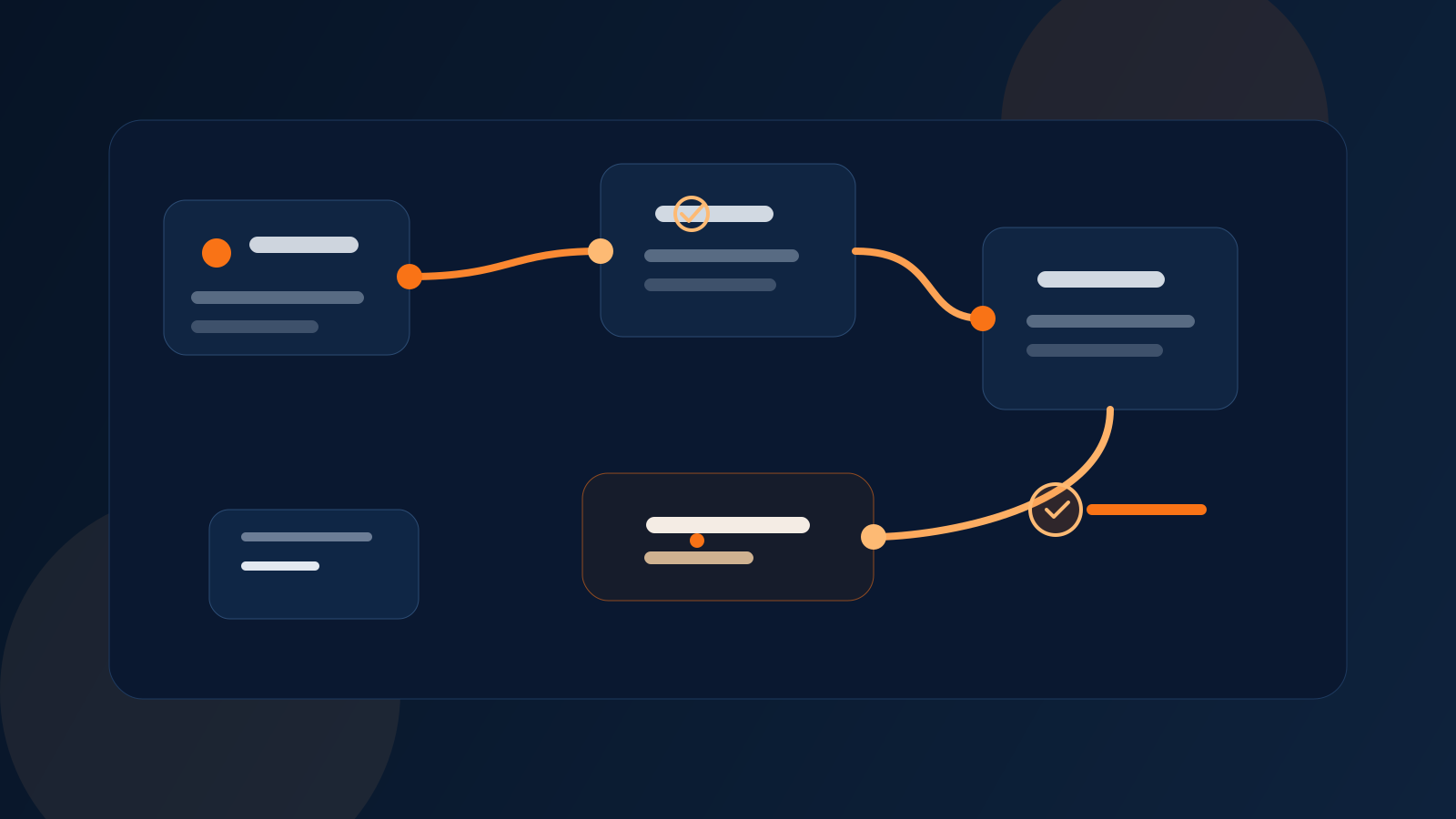
Agentic runbooks help IT operations teams move faster by collecting evidence, checking likely dependencies, and teeing up the next best action before a human approves anything risky.
TL;DR
- Traditional runbooks are useful, but they break down when incidents do not follow the expected path.
- Agentic runbooks are better at investigation than simple script execution because they gather context before acting.
- The best first use cases are high-volume, repetitive investigations where teams waste time jumping between dashboards, logs, tickets, and recent deploy history.
- The goal is not blind auto-remediation. The goal is faster, safer decisions with better evidence.
Why Old-School Runbooks Stop Helping When Incidents Get Messy
Most operations teams already have runbooks. The problem is that many of them were written for a cleaner world than the one we actually run in.
A classic runbook assumes the responder already knows where to look, which systems matter, and what "normal" looked like five minutes ago. Modern incidents rarely cooperate. A noisy alert could trace back to a bad deployment, a dependency issue, a cloud control-plane wobble, a permissions change, or one overloaded downstream service that quietly poisoned everything else.
That is where static runbooks start to feel like homework. They tell you what to click, but not what is most likely relevant right now.
What Makes a Runbook "Agentic"
An agentic runbook is still a runbook. It is just smarter about how it follows the path.
Instead of jumping straight into a fixed action list, it can:
- pull recent alerts, logs, and changes tied to the affected service
- check whether similar incidents happened before
- map likely dependencies and blast radius
- summarize what changed most recently
- recommend the next investigation step based on what it found
- hand a human a clean decision point before any meaningful action is taken
That matters because a lot of incident time is not spent fixing the issue. It is spent figuring out which issue you are actually looking at.
The Real Win Is Faster Context, Not Just Faster Clicks
There is a lot of market noise right now around agentic SOCs, AI incident response, and AI-assisted engineering workflows. That trend is real. What matters for operations teams, though, is not whether an agent can take actions. It is whether it can reduce time-to-context.
If an alert fires at 2:13 a.m., the first questions are usually boring and urgent:
- What changed?
- Which services depend on this?
- Is this isolated or spreading?
- Has this happened before?
- What evidence points to the most likely cause?
An agentic runbook can answer those questions much faster than a responder manually hopping across five tools and three Slack threads. That is the part that cuts MTTR.
Where Agentic Runbooks Help First
The best early use cases are not the most dramatic ones. They are the ones that happen all the time.
1. Repeated service degradation investigations
When latency spikes or error rates climb, responders often repeat the same evidence-gathering sequence. They check dashboards, recent deployments, logs, ticket context, and dependency health. Agentic runbooks are great at packaging that into one investigation flow.
2. Dependency and supply-chain incidents
Recent coverage of incidents like the Axios npm compromise is a good reminder that security events turn into operations events fast. Teams need to know where a risky package is deployed, what changed, which systems are exposed, and what to contain first.
3. Production debugging with guardrails
The Kubernetes community has been talking more openly about secure production debugging for a reason. During incidents, teams often overgrant access because it is the fastest route. Agentic runbooks give teams a better option: gather relevant evidence first, then escalate only when the data says it is necessary.
4. AI-generated change fallout
As AI-assisted development speeds up release volume, operations teams inherit more change surface area. That does not always mean more incidents, but it often means harder attribution. Agentic runbooks help correlate the incident with recent code, deploy, and config activity before the room turns chaotic.
What Good Guardrails Look Like
This is the part I care about most. If a vendor talks about autonomous operations without talking about guardrails, that is a red flag.
A useful agentic runbook should:
- show its evidence, not just its conclusion
- separate data gathering from state-changing actions
- make approvals explicit for risky steps
- keep an audit trail of what it checked and why
- degrade gracefully when a system is unavailable or data is incomplete
In other words, it should make humans more effective, not less accountable.
Where OpsRabbit Fits
OpsRabbit is well positioned for this model because the hard part of incident response is usually not opening another tool. It is connecting the right pieces of evidence fast enough to make a good decision.
That is exactly where an agentic runbook becomes useful.
OpsRabbit can sit between the alert and the action, assembling investigation context across signals, recent changes, dependencies, and prior incidents. Instead of dumping raw telemetry on the responder, it can help answer the practical question: what should we look at next, and why?
That is a much better operational posture than either extreme:
- a static checklist that ignores incident context
- a black-box automation loop that changes production before anyone understands the problem
Short Answer
Agentic runbooks are worth adopting when your team is losing time to repetitive investigation work, not when you are chasing flashy automation for its own sake.
If you want to reduce MTTR, start by shrinking the time between alert and useful context. That is the bottleneck most teams actually feel.
FAQs
What is an agentic runbook?
An agentic runbook is a guided operational workflow that gathers context, follows investigation steps, and recommends the next action instead of just executing a fixed script.
How is an agentic runbook different from traditional runbook automation?
Traditional automation usually executes predefined steps. Agentic runbooks adapt to incident context, collect evidence across systems, and keep a human in the loop for risky actions.
Sources
- Microsoft Security Blog - recent posts on incident response for AI and the agentic SOC, accessed April 17, 2026.
- Kubernetes Blog - recent post on securing production debugging in Kubernetes, accessed April 17, 2026.
- Datadog Blog - recent operations and AI observability coverage, accessed April 17, 2026.
- Google Cloud DevOps & SRE Blog - recent resilience and chaos-engineering coverage, accessed April 17, 2026.
- CISA Cybersecurity Alerts & Advisories - guidance categories for actionable response and mitigation, accessed April 17, 2026.
- GitHub Copilot Blog Index - recent agentic workflow and AI-assisted engineering coverage, accessed April 17, 2026.
Last Updated
2026-04-17
Ready to Transform Your Operations?
Ask for a demo today. Experience how OpsRabbit can reduce your MTTR by up to 90%.